Ch. 2 - General Chemistry Translated: Finding the Electrons
Mullins - Organic Chemistry: A Learner Centered Approach 1st Edition
Mullins1st EditionOrganic Chemistry: A Learner Centered ApproachISBN: 9780137566471Not the one you use?Change textbook
Chapter 1, Problem 16b

Give the charge most likely to result from ionization of the following metals.
(b) Aluminum

Verified step by step guidance
1
Identify the group of the periodic table where aluminum is located. Aluminum is in Group 13 (or Group IIIA in older notation). Elements in this group typically lose electrons to achieve a stable electron configuration.
Determine the electron configuration of aluminum. Aluminum has an atomic number of 13, so its electron configuration is: 1s22s22p63s23p1.
Recognize that aluminum will lose electrons to achieve a stable noble gas configuration. The nearest noble gas is neon, which has the electron configuration: 1s22s22p6.
Determine how many electrons aluminum needs to lose to achieve the neon configuration. Aluminum will lose three electrons: two from the 3s2 orbital and one from the 3p1 orbital.
Conclude that the most likely charge resulting from the ionization of aluminum is +3, as it loses three electrons to form the Al^3+ ion.

Verified video answer for a similar problem:

This video solution was recommended by our tutors as helpful for the problem above.
Video duration:
3m
Was this helpful?

Key Concepts

Here are the essential concepts you must grasp in order to answer the question correctly.

Ionization Energy

Ionization energy is the energy required to remove an electron from an atom or ion. For metals, this energy is generally lower than for nonmetals, making them more likely to lose electrons and form positive ions. Understanding ionization energy helps predict how easily a metal can ionize and the charge of the resulting ion.
Recommended video:
Guided course
04:28
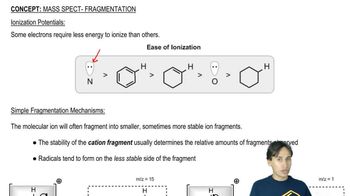
Ionization Potentials

Common Oxidation States

Metals often exhibit specific oxidation states based on their electron configuration. Aluminum, for instance, typically forms a +3 oxidation state when it ionizes, as it loses three electrons from its outer shell. Recognizing common oxidation states is crucial for predicting the charge of ions formed by different metals.
Recommended video:
Guided course
03:08
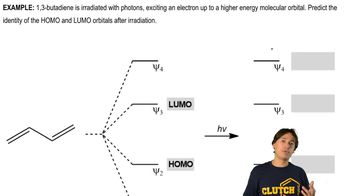
Ground vs. Excited States

Metallic Character

Metallic character refers to the tendency of an element to lose electrons and form positive ions. Elements with high metallic character, like aluminum, are more likely to ionize and form cations. This concept is essential for understanding the behavior of metals in chemical reactions and their resulting charges upon ionization.
Recommended video:
3:39
Metal Ion Catalysis Concept 1