Ch. 2 - General Chemistry Translated: Finding the Electrons
Mullins - Organic Chemistry: A Learner Centered Approach 1st Edition
Mullins1st EditionOrganic Chemistry: A Learner Centered ApproachISBN: 9780137566471Not the one you use?Change textbook
Chapter 1, Problem 74b

Connect the atoms using the indicated hybrid orbitals.
(b) C (sp2) with C (sp2)

Verified step by step guidance
1
Step 1: Understand the hybridization of the carbon atoms. Both carbon atoms are sp² hybridized, meaning they have one unhybridized p orbital and three sp² orbitals arranged in a trigonal planar geometry.
Step 2: Recognize the type of bond formed between two sp² hybridized carbons. The sp² orbitals will overlap to form a sigma (σ) bond, which is the primary bond connecting the two carbon atoms.
Step 3: Account for the unhybridized p orbitals. Each sp² hybridized carbon has one unhybridized p orbital perpendicular to the plane of the sp² orbitals. These p orbitals can overlap side-by-side to form a pi (π) bond.
Step 4: Combine the sigma and pi bonds to describe the overall bonding. The sigma bond forms the single framework connection, while the pi bond adds a second layer of bonding, resulting in a double bond between the two carbon atoms.
Step 5: Visualize the molecular geometry. The double bond (σ + π) between the two sp² hybridized carbons results in a planar structure with bond angles of approximately 120° around each carbon atom.

Verified video answer for a similar problem:

This video solution was recommended by our tutors as helpful for the problem above.
Video duration:
2m
Was this helpful?

Key Concepts

Here are the essential concepts you must grasp in order to answer the question correctly.

Hybridization

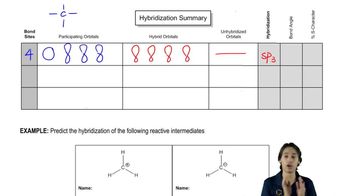
Hybridization is the process of combining atomic orbitals to form new hybrid orbitals that can accommodate bonding. In the case of sp² hybridization, one s orbital and two p orbitals from a carbon atom mix to create three equivalent sp² hybrid orbitals, which are oriented 120 degrees apart in a trigonal planar arrangement.
Recommended video:
Guided course
10:43
Using bond sites to predict hybridization

Bonding in Organic Molecules

In organic chemistry, carbon atoms often form covalent bonds with each other and other elements. The type of hybridization determines the geometry and bond angles of the molecule. For sp² hybridized carbons, the formation of sigma bonds occurs through the overlap of sp² orbitals, while pi bonds can form from the unhybridized p orbital.
Recommended video:
Guided course
02:17
Identifying organic molecules

Molecular Geometry

Molecular geometry refers to the three-dimensional arrangement of atoms in a molecule. The geometry is influenced by the type of hybridization and the number of bonds. For sp² hybridized carbon atoms, the resulting geometry is trigonal planar, which is crucial for understanding the spatial orientation of the bonds and the overall shape of the molecule.
Recommended video:
Guided course
07:44
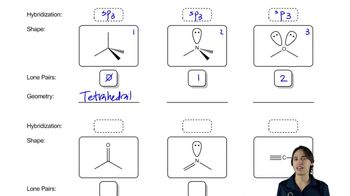
Molecular Geometry Explained.