Carbon dioxide (CO2) has no dipole moment (μ = 0 D). The related molecule sulfur dioxide (SO2) does have a dipole moment (μ = 1.6 D) Explain this observation.
Ch. 2 - General Chemistry Translated: Finding the Electrons

Mullins1st EditionOrganic Chemistry: A Learner Centered ApproachISBN: 9780137566471Not the one you use?Change textbook
All textbooks
Mullins 1st Edition
Ch. 2 - General Chemistry Translated: Finding the Electrons
Problem 77a
Mullins 1st Edition
Ch. 2 - General Chemistry Translated: Finding the Electrons
Problem 77aChapter 1, Problem 77a
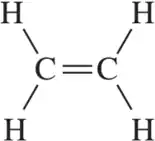
Given the Lewis structures, indicate the direction of the dipole moment, if there is one.
(a) 
Verified step by step guidance1
Examine the Lewis structure of the molecule to identify the atoms involved and their electronegativities. Recall that electronegativity is the tendency of an atom to attract electrons in a bond. The periodic trend is that electronegativity increases across a period (left to right) and decreases down a group (top to bottom).
Determine if the bonds in the molecule are polar. A bond is polar if there is a significant difference in electronegativity between the two atoms. Use the electronegativity values to assess whether the electrons are more attracted to one atom than the other.
For each polar bond, indicate the direction of the bond dipole moment. The dipole moment points from the less electronegative atom (partial positive, δ⁺) to the more electronegative atom (partial negative, δ⁻). Represent this with an arrow pointing toward the more electronegative atom, with a small plus sign at the tail of the arrow.
Analyze the geometry of the molecule to determine if the individual bond dipoles cancel out or if they combine to create a net dipole moment. Use VSEPR theory to predict the molecular shape and assess the symmetry of the dipoles.
If the molecule has a net dipole moment, indicate its direction. The net dipole moment is the vector sum of all individual bond dipoles. If the dipoles cancel out due to symmetry, the molecule is nonpolar; otherwise, it is polar with a net dipole moment in the direction of the resultant vector.

Verified video answer for a similar problem:
This video solution was recommended by our tutors as helpful for the problem above.
Video duration:
4mWas this helpful?
Key Concepts
Here are the essential concepts you must grasp in order to answer the question correctly.
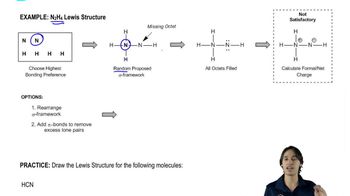
Lewis Structures
Lewis structures are diagrams that represent the bonding between atoms in a molecule and the lone pairs of electrons that may exist. They help visualize the arrangement of electrons and the connectivity of atoms, which is crucial for understanding molecular geometry and polarity.
Recommended video:
Guided course
Drawing the Lewis Structure for N2H4.
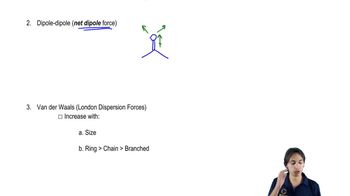
Dipole Moment
A dipole moment is a measure of the separation of positive and negative charges in a molecule, indicating its polarity. It is represented as a vector pointing from the positive to the negative charge, and its magnitude depends on the charge difference and the distance between the charges.
Recommended video:
Guided course
How dipole-dipole forces work.
Molecular Polarity
Molecular polarity arises from the uneven distribution of electron density within a molecule, often due to differences in electronegativity between bonded atoms. A molecule is polar if it has a net dipole moment, which can affect its physical properties and interactions with other molecules.
Recommended video:
Guided course
Molecular Polarity
Related Practice
Textbook Question
5
views
Textbook Question
For the following partial structures, the σ bond is shown. Add the indicated number of π bonds, being sure to specify the orientation (that is, x, y, or z axis) of the p orbitals used.
(e)
2
views
Textbook Question
Given the Lewis structures, indicate the direction of the dipole moment, if there is one.
(b)
4
views
Textbook Question
For the following partial structures, the bond is shown. Add the indicated number of bonds, being sure to specify the orientation (that is, x, y, or z axis) of the p orbitals used.
(c)
1
views
Textbook Question
Connect the atoms using the indicated hybrid orbitals.
(b) C (sp2) with C (sp2)
1
views
Textbook Question
Given the Lewis structures, indicate the direction of the dipole moment, if there is one.
(e)
1
views