Ch. 2 - General Chemistry Translated: Finding the Electrons
Mullins - Organic Chemistry: A Learner Centered Approach 1st Edition
Mullins1st EditionOrganic Chemistry: A Learner Centered ApproachISBN: 9780137566471Not the one you use?Change textbook
Chapter 1, Problem 70e,f,g

Predict the hybridization of all non-hydrogen atoms.
(e)
(f)
(g) Lewis structure of carbon dioxide showing double bonds between carbon and oxygen atoms.

Verified step by step guidance
1
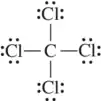
Step 1: Analyze the Lewis structure provided. The molecule consists of three carbon atoms bonded to hydrogen atoms and chlorine atoms. Each carbon atom is surrounded by four regions of electron density.
Step 2: Recall the concept of hybridization. Hybridization is determined by the number of regions of electron density (bonds and lone pairs) around an atom. For four regions of electron density, the hybridization is sp³.
Step 3: Examine the central carbon atoms. Each carbon atom is bonded to four other atoms (hydrogen or chlorine), indicating four regions of electron density. Therefore, the hybridization of each carbon atom is sp³.
Step 4: Consider the chlorine atoms. Each chlorine atom has three lone pairs and one bond to a carbon atom, resulting in four regions of electron density. Thus, the hybridization of each chlorine atom is also sp³.
Step 5: Summarize the hybridization. All non-hydrogen atoms (carbon and chlorine) in the molecule exhibit sp³ hybridization due to their four regions of electron density.

Verified video answer for a similar problem:

This video solution was recommended by our tutors as helpful for the problem above.
Video duration:
4m
Was this helpful?

Key Concepts

Here are the essential concepts you must grasp in order to answer the question correctly.

Hybridization

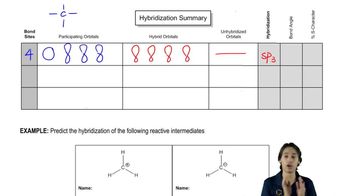
Hybridization is the concept of mixing atomic orbitals to form new hybrid orbitals that can accommodate bonding. In organic chemistry, it helps explain the geometry of molecules. For example, sp3 hybridization involves one s and three p orbitals, resulting in a tetrahedral shape, while sp2 and sp hybridizations lead to trigonal planar and linear geometries, respectively.
Recommended video:
Guided course
10:43
Using bond sites to predict hybridization

Lewis Structures

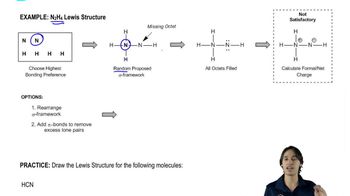
Lewis structures are diagrams that represent the bonding between atoms in a molecule and the lone pairs of electrons. They provide a visual way to understand the arrangement of electrons and the connectivity of atoms. In the context of hybridization, Lewis structures help identify the number of bonds and lone pairs around an atom, which are crucial for determining its hybridization state.
Recommended video:
Guided course
04:12
Drawing the Lewis Structure for N2H4.

Valence Shell Electron Pair Repulsion (VSEPR) Theory

VSEPR theory is used to predict the geometry of molecules based on the repulsion between electron pairs in the valence shell of atoms. It states that electron pairs will arrange themselves to minimize repulsion, leading to specific molecular shapes. Understanding VSEPR is essential for predicting the spatial arrangement of atoms in a molecule, which is directly related to the hybridization of the central atom.
Recommended video:
Guided course
03:40
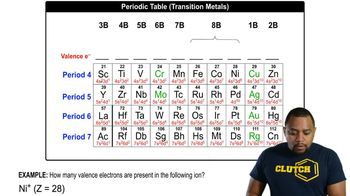
Valence Electrons of Transition Metals