
Ch. 14 - Structural Identification I: Infrared Spectroscopy and Mass Spectrometry
Mullins - Organic Chemistry: A Learner Centered Approach 1st Edition
Mullins1st EditionOrganic Chemistry: A Learner Centered ApproachISBN: 9780137566471Not the one you use?Change textbook
Chapter 13, Problem 58

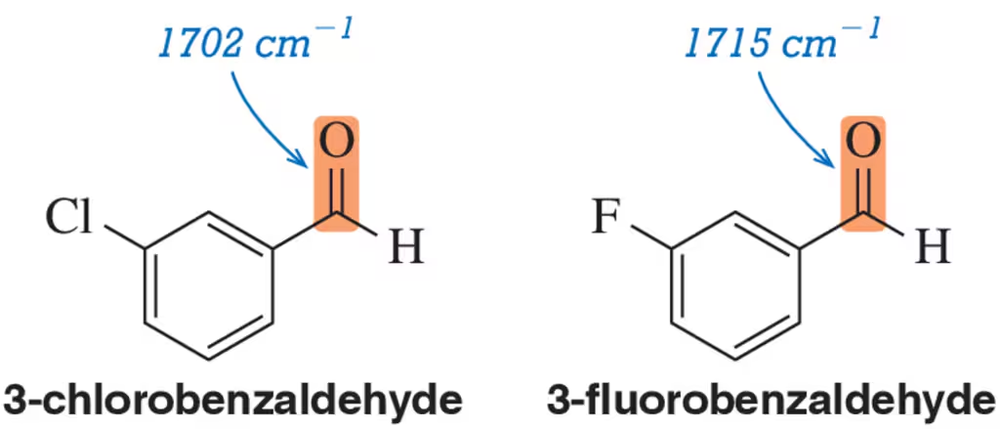
Justify the carbonyl stretching frequencies indicated for 3-chlorobenzaldehyde and 3-fluorobenzaldehyde.
Image showing carbonyl stretching frequencies: 1702 cm⁻¹ for 3-chlorobenzaldehyde, 1715 cm⁻¹ for 3-fluorobenzaldehyde.

Verified step by step guidance
1
Understand the concept of substituent effects on IR spectroscopy: Substituents on a benzene ring can influence the electronic environment of functional groups, such as carbonyls, affecting their IR stretching frequencies.
Identify the substituents: In this problem, we have 3-chlorobenzaldehyde and 3-fluorobenzaldehyde. Both compounds have a carbonyl group attached to a benzene ring, with chlorine and fluorine as substituents at the meta position.
Consider the electronic effects of the substituents: Chlorine and fluorine are both electronegative atoms, but fluorine is more electronegative than chlorine. This difference in electronegativity can affect the electron density around the carbonyl group.
Analyze the impact on carbonyl stretching frequency: The more electronegative fluorine can withdraw electron density more effectively than chlorine, potentially leading to a higher carbonyl stretching frequency for 3-fluorobenzaldehyde compared to 3-chlorobenzaldehyde.
Apply the concept to justify the observed frequencies: Based on the electronic effects discussed, predict that the carbonyl stretching frequency for 3-fluorobenzaldehyde will be higher than that for 3-chlorobenzaldehyde due to the stronger electron-withdrawing effect of fluorine.

Verified video answer for a similar problem:

This video solution was recommended by our tutors as helpful for the problem above.
Was this helpful?

Key Concepts

Here are the essential concepts you must grasp in order to answer the question correctly.

Electronic Effects of Substituents

Substituents on a benzene ring can influence the electronic distribution through resonance and inductive effects. Electron-withdrawing groups, like chlorine and fluorine, can affect the electron density of the ring and adjacent functional groups, such as carbonyls, altering their reactivity and properties, including IR absorption frequencies.
Recommended video:
2:02
Directing Effects in Substituted Pyrroles, Furans, and Thiophenes Concept 1

Infrared (IR) Spectroscopy

IR spectroscopy is a technique used to identify functional groups in a molecule by measuring the absorption of infrared light, which causes molecular vibrations. The carbonyl group typically shows a strong absorption band due to the C=O stretching vibration, and its frequency can be influenced by nearby substituents and their electronic effects.
Recommended video:
Guided course
16:04
General Features of IR Spect

Carbonyl Stretching Frequency

The carbonyl stretching frequency in IR spectroscopy is sensitive to the electronic environment around the carbonyl group. Electron-withdrawing substituents can increase the frequency by reducing electron density on the carbonyl carbon, making the C=O bond stronger and requiring more energy to stretch, thus shifting the absorption to a higher wavenumber.
Recommended video:
Guided course
16:47
Common IR Frequencies