Textbook Question
Would you expect the stretching band of the carbonyl to appear at a higher frequency for cyclohexanecarbaldehyde or benzaldehyde? Explain.
3
views

 Mullins 1st EditionCh. 14 - Structural Identification I: Infrared Spectroscopy and Mass SpectrometryProblem 56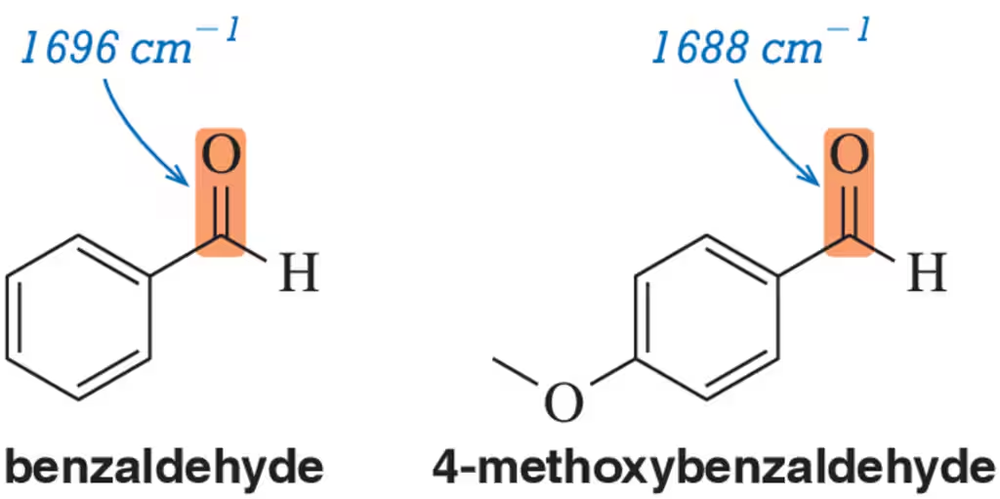
 Verified step by step guidance
 16:04
16:04
 16:47
16:47 09:04
09:04Would you expect the stretching band of the carbonyl to appear at a higher frequency for cyclohexanecarbaldehyde or benzaldehyde? Explain.
Justify the carbonyl stretching frequencies indicated for 3-chlorobenzaldehyde and 3-fluorobenzaldehyde.
Rank the following acetophenone derivatives on the basis of the carbonyl stretching frequency (1 = highest ; 4 = lowest ).
(a)
(b)
(c)
(d)
Under acidic conditions, alkene A can be isomerized to the more stable alkene B. How could IR spectroscopy be used to distinguish between A and B? [There are a few correct answers.]
Hoping to make the following diene, a chemist treated the diol shown with acid. Based on the IR spectrum, was the reaction successful? If not, what compound was made instead?
<IMAGE>
Justify the carbonyl stretching frequencies for a series of methoxybenzaldehydes. Specifically, why are the 2- and 4-methoxy derivatives similar to each other but different from the 3-methoxy derivative?