Predict the product and show an arrow-pushing mechanism for the first step of the alkoxymercuration reaction.
Ch. 13 - Alcohols, Ethers and Related Compounds: Substitution and Elimination

Mullins1st EditionOrganic Chemistry: A Learner Centered ApproachISBN: 9780137566471Not the one you use?Change textbook
All textbooks
Mullins 1st Edition
Ch. 13 - Alcohols, Ethers and Related Compounds: Substitution and Elimination
Problem 68
Mullins 1st Edition
Ch. 13 - Alcohols, Ethers and Related Compounds: Substitution and Elimination
Problem 68Chapter 12, Problem 68
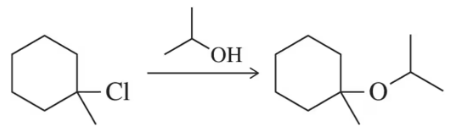
Why is the SN1 reaction shown an inefficient way of synthesizing ethers?

Verified step by step guidance1
The SN1 reaction mechanism involves the formation of a carbocation intermediate. In the given reaction, the leaving group is chloride (Cl-) from the cyclohexyl chloride, which forms a cyclohexyl carbocation.
Carbocations are prone to rearrangements, especially if a more stable carbocation can be formed. In this case, the cyclohexyl carbocation is relatively stable, but rearrangements can still occur, leading to side products.
The nucleophile in this reaction is isopropanol (CH3CHOHCH3). In SN1 reactions, the nucleophile attacks the carbocation, forming the ether product. However, the reaction can be inefficient due to competing reactions such as elimination, which can occur under similar conditions.
The SN1 mechanism is generally not preferred for synthesizing ethers because it often leads to a mixture of products due to the possibility of rearrangements and side reactions. This reduces the yield and purity of the desired ether product.
Alternative methods, such as the Williamson ether synthesis, are typically more efficient for synthesizing ethers. This method involves an SN2 reaction, which avoids carbocation intermediates and provides better control over the reaction outcome.

Verified video answer for a similar problem:
This video solution was recommended by our tutors as helpful for the problem above.
Was this helpful?
Key Concepts
Here are the essential concepts you must grasp in order to answer the question correctly.
S_N 1 Reaction Mechanism
The S_N 1 reaction is a nucleophilic substitution mechanism that involves two main steps: the formation of a carbocation intermediate and the subsequent attack of a nucleophile. This reaction is characterized by its unimolecular rate-determining step, meaning the rate depends only on the concentration of the substrate. The stability of the carbocation is crucial, as more stable carbocations lead to faster reactions.
Recommended video:
Guided course
Heck Reaction Mechanism
Carbocation Stability
Carbocation stability is a key factor in S_N 1 reactions, as more stable carbocations are formed from tertiary or resonance-stabilized substrates. The efficiency of the S_N 1 reaction in synthesizing ethers is limited because the formation of a stable carbocation can be slow, and if the carbocation is not sufficiently stable, it may lead to rearrangements or side reactions, reducing the yield of the desired ether.
Recommended video:
Guided course
Determining Carbocation Stability
Ethers and Their Synthesis
Ethers are organic compounds characterized by an oxygen atom bonded to two alkyl or aryl groups. The synthesis of ethers typically requires more efficient methods, such as the Williamson ether synthesis, which involves the reaction of an alkoxide ion with a primary alkyl halide. The S_N 1 mechanism is inefficient for ether synthesis because it can lead to a mixture of products, including alcohols and alkenes, rather than a clean ether product.
Recommended video:
Guided course
The Mechanism of Williamson Ether Synthesis.
Related Practice
Textbook Question
1
views
Textbook Question
Two different Williamson ether syntheses can be used to make the compound in (a). Show them. The compound in (b), however, can only be made one way. Show it and explain why a second Williamson ether synthesis is not possible.
(a)
5
views
Textbook Question
How could the reaction in Figure 13.67(b) be modified to produce the following ether?
1
views
Textbook Question
Predict the product of the following reactions. [Two of them are Williamson ether syntheses. Why isn't the other?].
(b)
2
views
Textbook Question
Starting with hydrogen sulfide, suggest a synthesis of the following thioether that makes use of two different haloalkanes.
10
views
Textbook Question
Predict the product of the following reactions. [Two of them are Williamson ether syntheses. Why isn't the other?].
(c)
4
views