Ch. 13 - Alcohols, Ethers and Related Compounds: Substitution and Elimination
Mullins - Organic Chemistry: A Learner Centered Approach 1st Edition
Mullins1st EditionOrganic Chemistry: A Learner Centered ApproachISBN: 9780137566471Not the one you use?Change textbook
Chapter 12, Problem 69

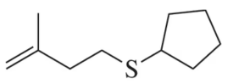
Starting with hydrogen sulfide, suggest a synthesis of the following thioether that makes use of two different haloalkanes.

Verified step by step guidance
1
Identify the target thioether structure, which consists of a sulfur atom bonded to two different alkyl groups: an allyl group and a cyclopentyl group.
Recognize that hydrogen sulfide (H₂S) can be deprotonated to form a sulfide ion (S²⁻), which can act as a nucleophile in substitution reactions.
Select two different haloalkanes that correspond to the alkyl groups in the target thioether. For the allyl group, use allyl bromide (CH₂=CHCH₂Br). For the cyclopentyl group, use cyclopentyl bromide (C₅H₉Br).
Perform a nucleophilic substitution reaction between the deprotonated hydrogen sulfide (S²⁻) and one of the haloalkanes, such as allyl bromide, to form an allyl sulfide intermediate.
React the allyl sulfide intermediate with the second haloalkane, cyclopentyl bromide, in another nucleophilic substitution reaction to form the final thioether product.

Verified video answer for a similar problem:

This video solution was recommended by our tutors as helpful for the problem above.
Was this helpful?

Key Concepts

Here are the essential concepts you must grasp in order to answer the question correctly.

Nucleophilic Substitution

Nucleophilic substitution is a fundamental reaction in organic chemistry where a nucleophile attacks an electrophile, resulting in the replacement of a leaving group. In the context of synthesizing thioethers from hydrogen sulfide and haloalkanes, the sulfur atom in hydrogen sulfide acts as a nucleophile, attacking the carbon atom bonded to the halogen in the haloalkane, leading to the formation of a thioether.
Recommended video:
Guided course
01:47
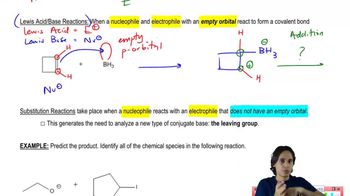
Nucleophiles and Electrophiles can react in Substitution Reactions.

Thioether Formation

Thioethers, also known as sulfides, are organic compounds containing a sulfur atom bonded to two alkyl or aryl groups. The synthesis of thioethers typically involves the reaction of hydrogen sulfide with haloalkanes through nucleophilic substitution. Understanding the structure and reactivity of thioethers is crucial for predicting the outcomes of such reactions and for designing synthetic pathways.
Recommended video:
Guided course
02:26
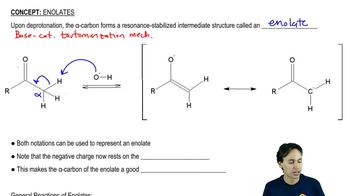
Formation of Enolates

Haloalkanes

Haloalkanes, or alkyl halides, are organic compounds containing one or more halogen atoms (such as chlorine, bromine, or iodine) attached to an alkane carbon chain. They are key reactants in nucleophilic substitution reactions, where the halogen serves as a leaving group. The choice of haloalkanes in the synthesis of thioethers can influence the reaction conditions and the efficiency of the synthesis process.