Ch. 13 - Alcohols, Ethers and Related Compounds: Substitution and Elimination
Mullins - Organic Chemistry: A Learner Centered Approach 1st Edition
Mullins1st EditionOrganic Chemistry: A Learner Centered ApproachISBN: 9780137566471Not the one you use?Change textbook
Chapter 12, Problem 71

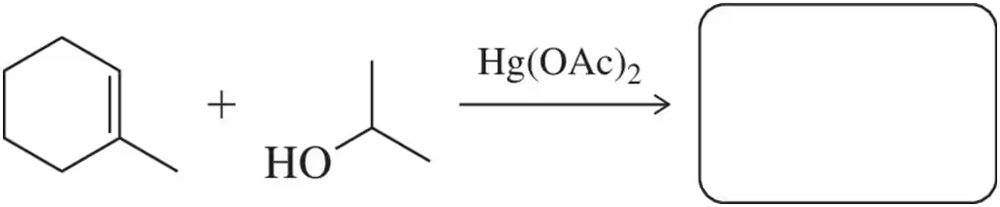
Predict the product and show an arrow-pushing mechanism for the first step of the alkoxymercuration reaction.
Cyclohexene reacts with isopropanol in the presence of mercuric acetate, showing the first step of alkoxymercuration.

Verified step by step guidance
1
Understand the alkoxymercuration reaction: This reaction involves the addition of an alcohol to an alkene in the presence of mercuric acetate, leading to the formation of an ether. The reaction proceeds through a Markovnikov addition, where the alcohol adds to the more substituted carbon of the alkene.
Identify the reactants: Typically, the reactants include an alkene, an alcohol, and mercuric acetate (Hg(OAc)₂). The alkene is the substrate that will undergo the addition reaction.
Initiate the reaction mechanism: The first step involves the formation of a mercurinium ion intermediate. The alkene reacts with mercuric acetate, where the π electrons of the alkene attack the mercury atom, forming a cyclic mercurinium ion. This is a key step in the mechanism.
Show the arrow-pushing for the mercurinium ion formation: Use curved arrows to indicate the movement of electrons. The π electrons from the alkene will attack the mercury atom, and simultaneously, one of the acetate groups will leave, forming the cyclic mercurinium ion.
Prepare for the next step: Once the mercurinium ion is formed, the alcohol will attack the more substituted carbon of the mercurinium ion, leading to the opening of the ring and formation of the ether product. This step involves nucleophilic attack and is crucial for the completion of the alkoxymercuration reaction.

Verified video answer for a similar problem:

This video solution was recommended by our tutors as helpful for the problem above.
Video duration:
9m
Was this helpful?

Key Concepts

Here are the essential concepts you must grasp in order to answer the question correctly.

Alkoxymercuration Reaction

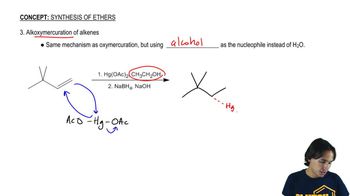
Alkoxymercuration is a chemical reaction that involves the addition of an alcohol across an alkene using mercuric acetate in the presence of an alcohol solvent. This reaction is used to form ethers and proceeds through a three-step mechanism: formation of a mercurinium ion, nucleophilic attack by the alcohol, and demercuration. Understanding this reaction is crucial for predicting the product and mechanism.
Recommended video:
Guided course
04:21
The Mechanism of Alkoxymercuation.

Mercurinium Ion Formation

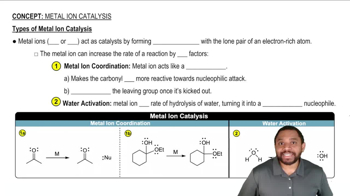
The first step in the alkoxymercuration reaction is the formation of a mercurinium ion. This occurs when the alkene reacts with mercuric acetate, leading to the formation of a three-membered ring intermediate. The mercurinium ion is a key intermediate that stabilizes the positive charge and directs the subsequent nucleophilic attack by the alcohol.
Recommended video:
3:39
Metal Ion Catalysis Concept 1

Arrow-Pushing Mechanism

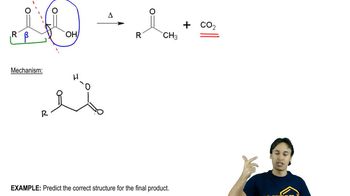
Arrow-pushing is a technique used to illustrate the movement of electrons during a chemical reaction. In the context of alkoxymercuration, it involves showing how the electrons from the alkene pi bond interact with the mercury ion to form the mercurinium ion, and how the alcohol attacks this intermediate. Mastery of arrow-pushing is essential for visualizing and understanding the step-by-step process of the reaction.
Recommended video:
Guided course
04:32
General Mechanism