Chapter 8 discussed the synthesis of cholesterol, which proceeds by a cationic cyclization cascade. Without looking back, suggest a mechanism by which the following reaction occurs. [The carbons have been numbered for you.]
Ch. 13 - Alcohols, Ethers and Related Compounds: Substitution and Elimination

Mullins1st EditionOrganic Chemistry: A Learner Centered ApproachISBN: 9780137566471Not the one you use?Change textbook
All textbooks
Mullins 1st Edition
Ch. 13 - Alcohols, Ethers and Related Compounds: Substitution and Elimination
Problem 118
Mullins 1st Edition
Ch. 13 - Alcohols, Ethers and Related Compounds: Substitution and Elimination
Problem 118Chapter 12, Problem 118
Assessment 8.74 revealed that oxymercuration could be used to make cyclic esters. Suggest a likely mechanism for this transformation.

Verified step by step guidance1
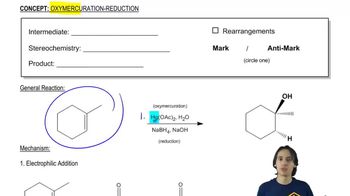
Step 1: Begin by understanding the oxymercuration reaction. Oxymercuration involves the addition of mercuric acetate (Hg(OAc)₂) to an alkene, forming a mercurinium ion intermediate.
Step 2: Analyze the structure of the starting material. The molecule contains an alkene and a hydroxyl group. The alkene is the site of the oxymercuration reaction.
Step 3: Consider the formation of the mercurinium ion. The alkene undergoes electrophilic addition with Hg(OAc)₂, forming a cyclic mercurinium ion. This intermediate is crucial for the subsequent steps.
Step 4: Examine the role of the hydroxyl group. The hydroxyl group can act as a nucleophile, attacking the mercurinium ion. This intramolecular attack leads to the formation of a cyclic ester.
Step 5: Complete the reaction with NaBH₄. Sodium borohydride (NaBH₄) is used to reduce the mercury-containing intermediate, replacing the mercury with a hydrogen atom, finalizing the formation of the cyclic ester.

Verified video answer for a similar problem:
This video solution was recommended by our tutors as helpful for the problem above.
Video duration:
7mWas this helpful?
Key Concepts
Here are the essential concepts you must grasp in order to answer the question correctly.
Oxymercuration-Demercuration
Oxymercuration is a reaction that involves the addition of mercuric acetate to an alkene, forming a mercurial intermediate. This process typically leads to the formation of alcohols through nucleophilic attack by water. The subsequent demercuration step replaces the mercury with a hydrogen atom, resulting in an alcohol product. Understanding this mechanism is crucial for predicting how cyclic esters can be formed from alkenes.
Recommended video:
Guided course
General properties of oxymercuration-reduction.
Cyclic Esters (Lactones)
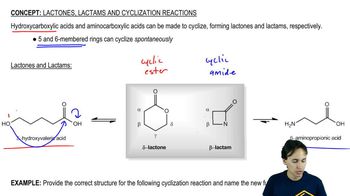
Cyclic esters, also known as lactones, are formed when a hydroxy acid undergoes intramolecular esterification. This process involves the reaction of a hydroxyl group with a carboxylic acid group within the same molecule, leading to the formation of a ring structure. Recognizing the conditions under which cyclic esters can form is essential for proposing a mechanism involving oxymercuration.
Recommended video:
Guided course
Lactones and Lactams
Mechanistic Pathways in Organic Reactions
Understanding mechanistic pathways is vital in organic chemistry as it describes the step-by-step sequence of events that occur during a chemical reaction. This includes identifying intermediates, transition states, and the role of catalysts. In the context of oxymercuration leading to cyclic esters, a clear grasp of these pathways will help in suggesting a plausible mechanism for the transformation.
Recommended video:
Energy Production In Biochemical Pathways Example 1
Related Practice
Textbook Question
2
views
Textbook Question
The acid-catalyzed dehydration we learned in this chapter is reversible, as shown below.
(b) Without looking back, how do you know this mechanism is correct?
4
views
Textbook Question
The acid-catalyzed dehydration we learned in this chapter is reversible, as shown below.
(c) Which side of the reaction would be favored by running the reaction at low temperatures?
6
views
Textbook Question
The acid-catalyzed dehydration we learned in this chapter is reversible, as shown below.
(d) How might you shift the equilibrium to the right?
3
views
Textbook Question
Suggest reagents to carry out the following transformation.