Ch. 13 - Alcohols, Ethers and Related Compounds: Substitution and Elimination
Mullins - Organic Chemistry: A Learner Centered Approach 1st Edition
Mullins1st EditionOrganic Chemistry: A Learner Centered ApproachISBN: 9780137566471Not the one you use?Change textbook
Chapter 12, Problem 120

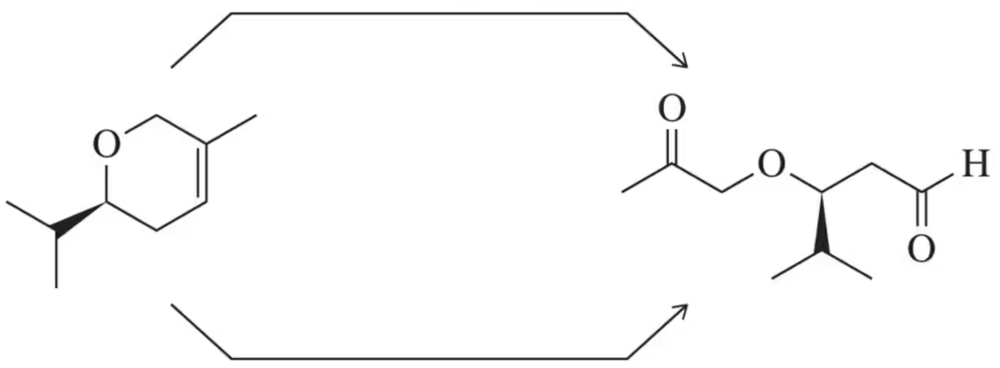
Suggest reagents to carry out the following transformation.
Chemical structure illustrating ozonolysis with arrows indicating reaction pathways and functional groups involved.

Verified step by step guidance
1
Identify the functional groups in the starting material and the product. The starting material is a cyclic ketone, and the product is an ester with an additional carboxylic acid group.
Recognize that the transformation involves opening the ring and introducing an ester and a carboxylic acid group. This suggests a Baeyer-Villiger oxidation followed by esterification.
Select a reagent for Baeyer-Villiger oxidation. A common reagent for this transformation is a peroxyacid, such as mCPBA (meta-chloroperoxybenzoic acid), which can convert ketones to esters.
Consider the conditions needed for esterification. After the Baeyer-Villiger oxidation, the resulting lactone can be opened using an alcohol in acidic conditions to form the ester.
Chapter 9 often discusses oxidation reactions, including Baeyer-Villiger oxidation. Ensure the chosen reagents align with the concepts from this chapter, focusing on oxidation and functional group transformations.

Verified video answer for a similar problem:

This video solution was recommended by our tutors as helpful for the problem above.
Video duration:
3m
Was this helpful?

Key Concepts

Here are the essential concepts you must grasp in order to answer the question correctly.

Reagents in Organic Reactions

Reagents are substances that are added to a chemical reaction to cause a transformation. In organic chemistry, selecting the appropriate reagents is crucial for achieving the desired product. Different reagents can facilitate various types of reactions, such as oxidation, reduction, or substitution, and understanding their roles helps in predicting the outcome of the reaction.
Recommended video:
Guided course
02:17
Identifying organic molecules

Functional Groups

Functional groups are specific groups of atoms within molecules that are responsible for the characteristic chemical reactions of those molecules. Identifying the functional groups present in the reactants and products is essential for determining the appropriate reagents and reaction conditions. Knowledge of functional groups allows chemists to predict reactivity and select suitable transformation pathways.
Recommended video:
Guided course
02:36
Identifying Functional Groups

Reaction Mechanisms

A reaction mechanism is a step-by-step description of the process by which reactants are converted into products. Understanding the mechanism helps in identifying the intermediates and transition states involved in the reaction. This knowledge is vital for selecting the right reagents and conditions, as it provides insight into how the reaction proceeds and what might be required to facilitate the transformation.
Recommended video:
Guided course
02:16
Heck Reaction Mechanism