Ch. 13 - Alcohols, Ethers and Related Compounds: Substitution and Elimination
Mullins - Organic Chemistry: A Learner Centered Approach 1st Edition
Mullins1st EditionOrganic Chemistry: A Learner Centered ApproachISBN: 9780137566471Not the one you use?Change textbook
Chapter 12, Problem 117b

The acid-catalyzed dehydration we learned in this chapter is reversible, as shown below.
Chemical equation illustrating acid-catalyzed hydration with water, sulfuric acid, and an alcohol product.
(b) Without looking back, how do you know this mechanism is correct?

Verified step by step guidance
1
Step 1: Recognize that the reaction shown is an acid-catalyzed hydration-dehydration equilibrium. The presence of H₂SO₄ (sulfuric acid) indicates acid catalysis, which facilitates both the addition of water to the alkene and the reverse dehydration reaction.
Step 2: Understand the mechanism of acid-catalyzed hydration. The alkene undergoes protonation by H⁺ from H₂SO₄, forming a carbocation intermediate. This intermediate is stabilized and then attacked by water (H₂O), leading to the formation of the alcohol product.
Step 3: Recall that the reverse reaction (dehydration) is also acid-catalyzed. The alcohol can lose a proton to form a carbocation, followed by elimination of water to regenerate the alkene. This reversibility is a hallmark of acid-catalyzed hydration-dehydration reactions.
Step 4: Verify the correctness of the mechanism by considering Markovnikov's rule. In the hydration step, the proton adds to the less substituted carbon of the double bond, forming the more stable carbocation intermediate, which leads to the correct alcohol product.
Step 5: Confirm that the reaction is consistent with principles of equilibrium. The reaction can proceed in either direction depending on the conditions (e.g., excess water favors hydration, while removal of water favors dehydration). This reversibility ensures the mechanism is correct.

Verified video answer for a similar problem:

This video solution was recommended by our tutors as helpful for the problem above.
Was this helpful?

Key Concepts

Here are the essential concepts you must grasp in order to answer the question correctly.

Acid-Catalyzed Dehydration

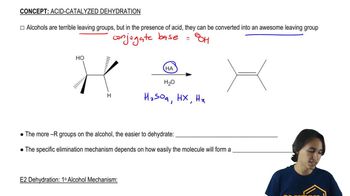
Acid-catalyzed dehydration is a chemical reaction where an alcohol is converted into an alkene through the removal of a water molecule, facilitated by an acid. This process typically involves protonation of the alcohol, leading to the formation of a better leaving group, and subsequent elimination of water. Understanding this mechanism is crucial as it highlights the role of acids in promoting the reaction and the reversibility of the process.
Recommended video:
Guided course
06:01
General features of acid-catalyzed dehydration.

Reversibility of Reactions

Reversibility in chemical reactions refers to the ability of a reaction to proceed in both the forward and reverse directions. In the context of acid-catalyzed dehydration, this means that the formation of the alkene can be reversed by the addition of water, regenerating the alcohol. Recognizing this characteristic is essential for predicting the behavior of the reaction under different conditions and understanding equilibrium.
Recommended video:
Guided course
11:50
EAS Reactions Overview

Mechanism of Reaction

The mechanism of a reaction describes the step-by-step sequence of elementary reactions that lead to the overall transformation of reactants into products. In acid-catalyzed dehydration, the mechanism involves protonation, formation of a carbocation, and elimination of water. Knowing the mechanism is vital for validating the correctness of the reaction pathway and for predicting the products formed under various conditions.
Recommended video:
Guided course
02:16
Heck Reaction Mechanism