Ch. 13 - Alcohols, Ethers and Related Compounds: Substitution and Elimination
Mullins - Organic Chemistry: A Learner Centered Approach 1st Edition
Mullins1st EditionOrganic Chemistry: A Learner Centered ApproachISBN: 9780137566471Not the one you use?Change textbook
Chapter 12, Problem 51d

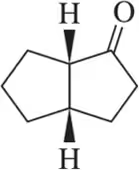
Identify the alcohols that would undergo oxidation to produce the following carbonyl compounds.
(d) Chemical structure of a cyclohexanone molecule with a ketone group and two hydrogen atoms attached to the ring.

Verified step by step guidance
1
Understand that oxidation of alcohols involves the conversion of the hydroxyl group (-OH) into a carbonyl group (C=O). Primary alcohols are oxidized to aldehydes, which can further oxidize to carboxylic acids, while secondary alcohols are oxidized to ketones.
Identify the type of carbonyl compound given in the problem. If it is an aldehyde, the precursor is likely a primary alcohol. If it is a ketone, the precursor is likely a secondary alcohol.
Examine the structure of the given carbonyl compound. Determine the number of carbon atoms and the position of the carbonyl group to deduce the structure of the original alcohol.
For an aldehyde, remove the oxygen double bond and add a hydrogen to the carbonyl carbon to form the corresponding primary alcohol. For a ketone, remove the oxygen double bond and add a hydrogen to the carbonyl carbon to form the corresponding secondary alcohol.
Verify the structure of the alcohol by considering the oxidation process. Ensure that the oxidation of the identified alcohol would indeed yield the given carbonyl compound.

Verified video answer for a similar problem:

This video solution was recommended by our tutors as helpful for the problem above.
Video duration:
4m
Was this helpful?

Key Concepts

Here are the essential concepts you must grasp in order to answer the question correctly.

Oxidation of Alcohols

Oxidation of alcohols involves the conversion of alcohols into carbonyl compounds, such as aldehydes or ketones. Primary alcohols typically oxidize to form aldehydes, which can further oxidize to carboxylic acids, while secondary alcohols oxidize to form ketones. Tertiary alcohols generally do not undergo oxidation due to the lack of a hydrogen atom on the carbon bearing the hydroxyl group.
Recommended video:
Guided course
05:53
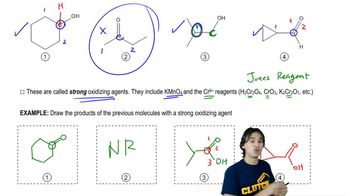
Strong oxidizing agents

Primary and Secondary Alcohols

Primary alcohols have the hydroxyl group (-OH) attached to a carbon atom that is bonded to only one other carbon atom, while secondary alcohols have the hydroxyl group attached to a carbon atom bonded to two other carbon atoms. The structure of the alcohol determines the type of carbonyl compound formed upon oxidation: aldehydes from primary alcohols and ketones from secondary alcohols.
Recommended video:
1:24
Secondary Protein Structure Example 2

Carbonyl Compounds

Carbonyl compounds are organic molecules containing a carbon-oxygen double bond. The two main types are aldehydes, where the carbonyl group is bonded to at least one hydrogen atom, and ketones, where the carbonyl group is bonded to two carbon atoms. Identifying the type of carbonyl compound formed helps determine the original alcohol that underwent oxidation.
Recommended video:
Guided course
01:40
Defining meso compounds.