Ch. 13 - Alcohols, Ethers and Related Compounds: Substitution and Elimination
Mullins - Organic Chemistry: A Learner Centered Approach 1st Edition
Mullins1st EditionOrganic Chemistry: A Learner Centered ApproachISBN: 9780137566471Not the one you use?Change textbook
Chapter 12, Problem 51b

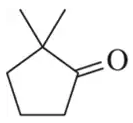
Identify the alcohols that would undergo oxidation to produce the following carbonyl compounds.
(b)

Verified step by step guidance
1
Examine the structure of the given carbonyl compound. It is a ketone, characterized by a carbonyl group (C=O) bonded to two carbon atoms.
Identify the carbon atoms adjacent to the carbonyl group. In this structure, the carbonyl group is bonded to a cyclopentane ring and a tertiary butyl group.
Determine the alcohol precursor for the ketone. Ketones are typically formed from secondary alcohols through oxidation.
Consider the structure of the secondary alcohol that would lead to this ketone. The secondary alcohol would have a hydroxyl group (-OH) attached to the carbon that is bonded to the cyclopentane ring and the tertiary butyl group.
Visualize the transformation: The secondary alcohol undergoes oxidation, where the hydroxyl group is converted into a carbonyl group, resulting in the ketone shown in the image.

Verified video answer for a similar problem:

This video solution was recommended by our tutors as helpful for the problem above.
Video duration:
1m
Was this helpful?

Key Concepts

Here are the essential concepts you must grasp in order to answer the question correctly.

Alcohol Oxidation

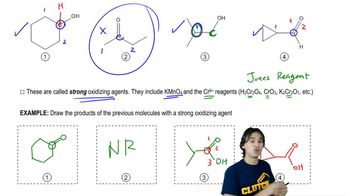
Alcohol oxidation involves the conversion of alcohols into carbonyl compounds, such as aldehydes or ketones, through the removal of hydrogen atoms. Primary alcohols typically oxidize to aldehydes, while secondary alcohols convert to ketones. The process can be facilitated by oxidizing agents like potassium dichromate or PCC (pyridinium chlorochromate). Understanding the type of alcohol and the conditions of oxidation is crucial for predicting the resulting carbonyl compound.
Recommended video:
Guided course
05:53
Strong oxidizing agents

Types of Alcohols

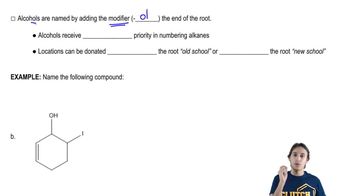
Alcohols are classified into three categories: primary, secondary, and tertiary. Primary alcohols have the hydroxyl group (-OH) attached to a carbon that is connected to only one other carbon, secondary alcohols are attached to a carbon connected to two others, and tertiary alcohols are connected to three. This classification affects their reactivity and the products formed during oxidation, making it essential to identify the type of alcohol when predicting the outcome of oxidation reactions.
Recommended video:
Guided course
01:01
How to name alcohols

Carbonyl Compounds

Carbonyl compounds are organic molecules that contain a carbon atom double-bonded to an oxygen atom (C=O). They include aldehydes and ketones, which differ in the position of the carbonyl group. Aldehydes have the carbonyl group at the end of the carbon chain, while ketones have it within the chain. Recognizing the structure and properties of these compounds is vital for understanding the products of alcohol oxidation and their potential applications in organic synthesis.
Recommended video:
Guided course
01:40
Defining meso compounds.