Ch. 12 - Substitution and Elimination: Reactions of Haloalkanes
Mullins - Organic Chemistry: A Learner Centered Approach 1st Edition
Mullins1st EditionOrganic Chemistry: A Learner Centered ApproachISBN: 9780137566471Not the one you use?Change textbook
Chapter 11, Problem 4

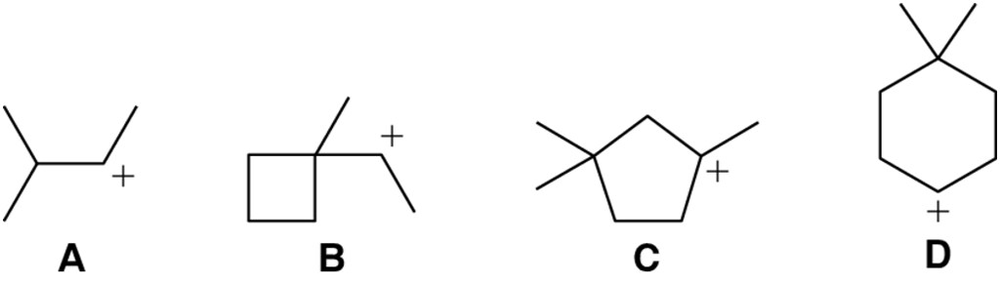
Which of the following carbocations would you expect to rearrange?
Four carbocation structures labeled A, B, C, and D, with plus signs indicating positive charges.

Verified step by step guidance
1
Step 1: Understand the concept of carbocation rearrangement. Carbocations rearrange to form a more stable carbocation. Stability is influenced by factors such as hyperconjugation, inductive effects, and resonance. Tertiary carbocations are more stable than secondary, which are more stable than primary.
Step 2: Analyze carbocation A. The carbocation is secondary and adjacent to a quaternary carbon. A hydride shift or methyl shift could occur to form a tertiary carbocation, which is more stable.
Step 3: Analyze carbocation B. The carbocation is secondary and part of a cyclohexane ring. A hydride shift or ring expansion could occur to form a tertiary carbocation or relieve ring strain, increasing stability.
Step 4: Analyze carbocation C. The carbocation is secondary and surrounded by alkyl groups. However, there is no nearby tertiary carbon or resonance stabilization opportunity, so rearrangement is unlikely.
Step 5: Analyze carbocation D. The carbocation is secondary and part of a strained cyclobutane ring. A ring expansion to cyclopentane could occur, relieving strain and forming a more stable carbocation.

Verified video answer for a similar problem:

This video solution was recommended by our tutors as helpful for the problem above.
Video duration:
7m
Was this helpful?

Key Concepts

Here are the essential concepts you must grasp in order to answer the question correctly.

Carbocation Stability

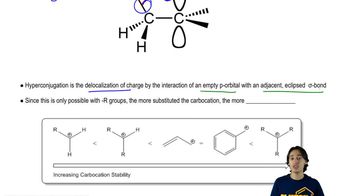
Carbocations are positively charged carbon species that can rearrange to form more stable structures. Stability is influenced by the degree of substitution: tertiary carbocations are more stable than secondary, which are more stable than primary. This stability is due to hyperconjugation and inductive effects from surrounding alkyl groups.
Recommended video:
Guided course
05:58
Determining Carbocation Stability

Rearrangement Mechanisms

Carbocation rearrangements typically occur through hydride or alkyl shifts, where adjacent atoms or groups move to stabilize the positive charge. This process can lead to the formation of more stable carbocations, often resulting in a change in the carbon skeleton. Recognizing potential shifts is crucial for predicting rearrangement.
Recommended video:
Guided course
06:08
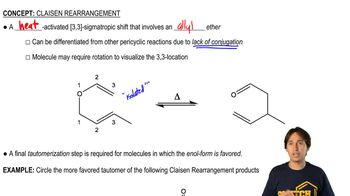
Definition of Claisen Rearrangement

Types of Carbocations

Carbocations can be classified as primary, secondary, or tertiary based on the number of carbon atoms attached to the positively charged carbon. Additionally, they can be classified as allylic or benzylic if they are adjacent to a double bond or aromatic ring, respectively. These classifications help in predicting their reactivity and stability.
Recommended video:
Guided course
05:58
Determining Carbocation Stability