Ch. 12 - Substitution and Elimination: Reactions of Haloalkanes
Mullins - Organic Chemistry: A Learner Centered Approach 1st Edition
Mullins1st EditionOrganic Chemistry: A Learner Centered ApproachISBN: 9780137566471Not the one you use?Change textbook
Chapter 11, Problem 5a

Given that step 1 of the following reaction is rate determining, write the rate law for the overall reaction.
Energy diagram illustrating a chemical reaction with arrows indicating electron movement and a rate-determining step.

Verified step by step guidance
1
Identify the rate-determining step in the reaction mechanism. The rate-determining step is the slowest step in the sequence of steps that make up the reaction mechanism. This step controls the overall rate of the reaction.
Write the rate law based on the rate-determining step. The rate law is determined by the reactants involved in the rate-determining step and their respective concentrations. For example, if the rate-determining step involves reactants A and B, the rate law will take the form: Rate=k[A][B], where k is the rate constant.
Determine the molecularity of the rate-determining step. Molecularity refers to the number of reactant molecules involved in the step. For example, if the step involves one molecule, it is unimolecular, and if it involves two molecules, it is bimolecular.
Ensure that the rate law reflects the stoichiometry of the rate-determining step. The exponents in the rate law correspond to the stoichiometric coefficients of the reactants in the rate-determining step.
Verify that the rate law is consistent with experimental data, if provided. Experimental data can confirm whether the proposed rate law accurately describes the reaction kinetics.

Verified video answer for a similar problem:

This video solution was recommended by our tutors as helpful for the problem above.
Video duration:
3m
Was this helpful?

Key Concepts

Here are the essential concepts you must grasp in order to answer the question correctly.

Rate Determining Step

The rate determining step (RDS) is the slowest step in a reaction mechanism that dictates the overall reaction rate. It is crucial because the rate law can be derived from the stoichiometry of this step. Understanding which step is the RDS allows chemists to focus on the relevant reactants and their concentrations when formulating the rate law.
Recommended video:
5:07
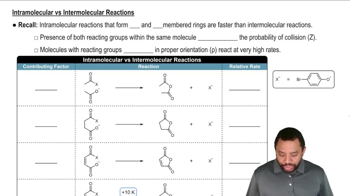
Rates of Intramolecular Reactions Concept 2

Rate Law

The rate law expresses the relationship between the rate of a chemical reaction and the concentration of its reactants. It is typically formulated as rate = k[A]^m[B]^n, where k is the rate constant, and m and n are the orders of the reaction with respect to reactants A and B. The rate law can be determined experimentally or derived from the RDS of the reaction mechanism.
Recommended video:
5:07
Rates of Intramolecular Reactions Concept 2

Reaction Mechanism

A reaction mechanism is a detailed description of the step-by-step process by which reactants are converted into products. It includes all elementary steps, intermediates, and the RDS. Understanding the mechanism is essential for predicting the rate law and the effect of various conditions on the reaction rate, as it provides insight into how the reaction proceeds at a molecular level.
Recommended video:
Guided course
02:16
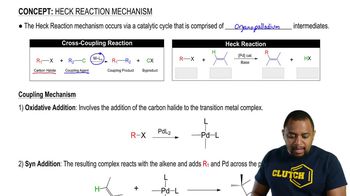
Heck Reaction Mechanism