Ch. 12 - Substitution and Elimination: Reactions of Haloalkanes
Mullins - Organic Chemistry: A Learner Centered Approach 1st Edition
Mullins1st EditionOrganic Chemistry: A Learner Centered ApproachISBN: 9780137566471Not the one you use?Change textbook
Chapter 11, Problem 6

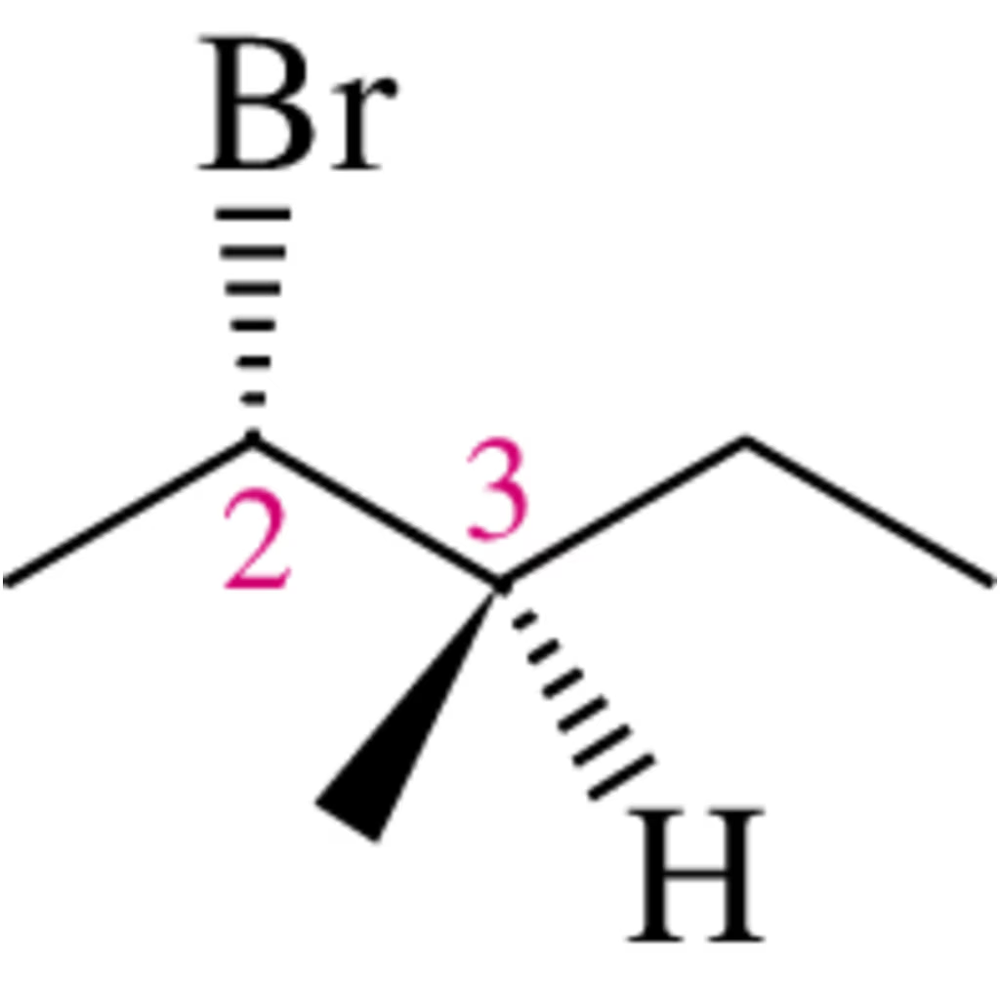
For the following molecule, draw the Newman projection (around the 2,3-bond) with a dihedral angle of 180° between the bromine and hydrogen.
Newman projection of a molecule showing a bromine and hydrogen with a 180° dihedral angle around the 2,3-bond.

Verified step by step guidance
1
Identify the 2,3-bond in the given molecule. This bond will serve as the axis for the Newman projection. Assign the carbon at position 2 as the front carbon and the carbon at position 3 as the rear carbon for the projection.
Determine the substituents attached to the front carbon (C-2). These substituents will radiate outward from the center of the Newman projection. Label them clearly (e.g., bromine, hydrogen, and any other group).
Determine the substituents attached to the rear carbon (C-3). These substituents will also radiate outward but will be drawn behind the front carbon in the Newman projection. Label them clearly (e.g., hydrogen and any other groups).
Position the substituents such that the dihedral angle between the bromine on the front carbon and the hydrogen on the rear carbon is 180°. This means they should be directly opposite each other in the Newman projection (anti-periplanar arrangement).
Draw the Newman projection with the front carbon substituents arranged in a Y-shape and the rear carbon substituents arranged in a circle behind it. Ensure the bromine and hydrogen are anti to each other, and label all substituents for clarity.

Verified video answer for a similar problem:

This video solution was recommended by our tutors as helpful for the problem above.
Video duration:
4m
Was this helpful?

Key Concepts

Here are the essential concepts you must grasp in order to answer the question correctly.

Newman Projection

A Newman projection is a way of visualizing the conformation of a molecule by looking straight down the bond connecting two carbon atoms. This representation helps in understanding the spatial arrangement of substituents around the bond, which is crucial for analyzing steric interactions and torsional strain in organic molecules.
Recommended video:
Guided course
00:34
Introduction to Drawing Newman Projections

Dihedral Angle

The dihedral angle is the angle between two planes formed by four atoms in a molecule. In the context of a Newman projection, it describes the relative orientation of substituents on adjacent carbon atoms. A dihedral angle of 180° indicates that the substituents are in an anti conformation, which is often more stable due to minimized steric hindrance.
Recommended video:
Guided course
02:46
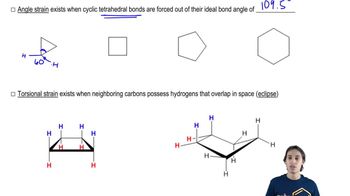
What is angle strain?

Steric Hindrance

Steric hindrance refers to the repulsion between atoms that occurs when they are brought close together, affecting the stability and reactivity of a molecule. In the context of the Newman projection, understanding steric hindrance is essential for predicting the most stable conformations, as bulky groups can create unfavorable interactions when positioned too closely.
Recommended video:
Guided course
02:53
Understanding steric effects.