Ch. 12 - Substitution and Elimination: Reactions of Haloalkanes
Mullins - Organic Chemistry: A Learner Centered Approach 1st Edition
Mullins1st EditionOrganic Chemistry: A Learner Centered ApproachISBN: 9780137566471Not the one you use?Change textbook
Chapter 11, Problem 32b

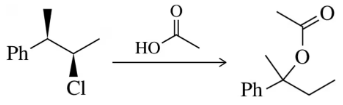
Provide a mechanism for the following SN1 reactions that feature a rearrangement.
(b)

Verified step by step guidance
1
Step 1: Identify the reaction type. This is an SN1 reaction, which proceeds via a two-step mechanism involving the formation of a carbocation intermediate.
Step 2: The first step is the departure of the leaving group (Cl⁻) from the substrate, forming a carbocation. The substrate is benzyl chloride, and the benzyl group stabilizes the carbocation through resonance.
Step 3: Analyze the carbocation intermediate for possible rearrangements. In this case, a hydride shift occurs to form a more stable tertiary carbocation. The hydride shift involves the migration of a hydrogen atom with its bonding electrons from an adjacent carbon to the carbocation center.
Step 4: Once the tertiary carbocation is formed, the nucleophile (acetic acid, CH₃COOH) attacks the carbocation. The oxygen atom in acetic acid donates a lone pair of electrons to form a bond with the carbocation.
Step 5: The final step involves deprotonation of the intermediate formed after nucleophilic attack, resulting in the formation of the product, which is an ester with a phenyl group and a tertiary carbon center.

Verified video answer for a similar problem:

This video solution was recommended by our tutors as helpful for the problem above.
Was this helpful?

Key Concepts

Here are the essential concepts you must grasp in order to answer the question correctly.

Sₙ1 Reaction Mechanism

The Sₙ1 (substitution nucleophilic unimolecular) reaction mechanism involves a two-step process where the first step is the formation of a carbocation intermediate after the leaving group departs. This intermediate is then attacked by a nucleophile in the second step. The rate of the reaction depends only on the concentration of the substrate, making it unimolecular.
Recommended video:
Guided course
02:16
Heck Reaction Mechanism

Carbocation Stability and Rearrangement

Carbocations are positively charged species that can undergo rearrangement to form more stable structures. Stability increases with the degree of substitution (tertiary > secondary > primary). Rearrangement can occur through hydride or alkyl shifts, allowing the carbocation to transition to a more stable form before the nucleophilic attack.
Recommended video:
Guided course
05:58
Determining Carbocation Stability

Nucleophilic Attack

Nucleophilic attack is the process where a nucleophile donates a pair of electrons to an electrophile, forming a new bond. In Sₙ1 reactions, this occurs after the formation of the carbocation. The nucleophile can attack from either side of the planar carbocation, leading to potential stereochemical outcomes, including racemization if the substrate is chiral.
Recommended video:
Guided course
08:27
Nucleophilic Addition