Ch. 12 - Substitution and Elimination: Reactions of Haloalkanes
Mullins - Organic Chemistry: A Learner Centered Approach 1st Edition
Mullins1st EditionOrganic Chemistry: A Learner Centered ApproachISBN: 9780137566471Not the one you use?Change textbook
Chapter 11, Problem 32a

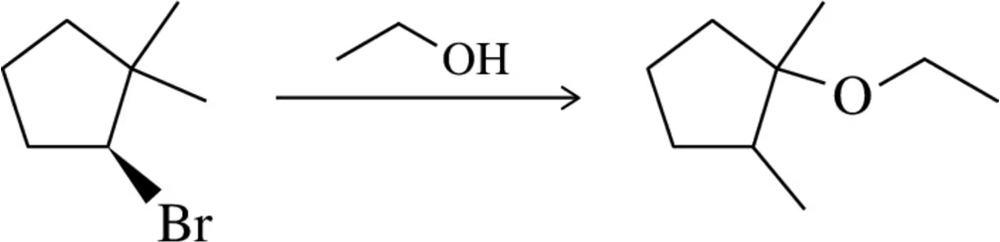
Provide a mechanism for the following SN1 reactions that feature a rearrangement.
(a) Mechanism illustration of an SN1 reaction showing a bromine atom and hydroxyl group rearrangement.

Verified step by step guidance
1
Step 1: Identify the substrate and the leaving group. In an Sₙ1 reaction, the substrate is typically a tertiary or secondary alkyl halide, and the leaving group is a halide ion (e.g., Cl⁻, Br⁻, or I⁻). The reaction begins with the departure of the leaving group, forming a carbocation intermediate.
Step 2: Analyze the stability of the carbocation intermediate. Carbocations are stabilized by hyperconjugation and inductive effects. If the initially formed carbocation is not the most stable, a rearrangement (e.g., hydride shift or alkyl shift) may occur to form a more stable carbocation.
Step 3: Draw the rearrangement mechanism. For example, if a hydride shift occurs, a hydrogen atom (along with its bonding electrons) moves from an adjacent carbon to the carbocation center, resulting in a more stable carbocation. Alternatively, an alkyl group may shift in a similar manner.
Step 4: Once the most stable carbocation is formed, the nucleophile attacks the carbocation. The nucleophile (e.g., water, alcohol, or another electron-rich species) donates a pair of electrons to the positively charged carbocation, forming a new bond.
Step 5: If necessary, perform a proton transfer to complete the reaction. For example, if the nucleophile is water, the product may initially be a protonated alcohol, which then loses a proton to yield the final neutral product.

Verified video answer for a similar problem:

This video solution was recommended by our tutors as helpful for the problem above.
Video duration:
5m
Was this helpful?

Key Concepts

Here are the essential concepts you must grasp in order to answer the question correctly.

Sₙ1 Mechanism

The Sₙ1 (substitution nucleophilic unimolecular) mechanism involves a two-step process where the rate-determining step is the formation of a carbocation intermediate. This occurs when a leaving group departs, creating a positively charged carbon atom. The subsequent step involves a nucleophile attacking the carbocation, leading to the formation of the final product. Understanding this mechanism is crucial for predicting reaction outcomes and rearrangements.
Recommended video:
Guided course
04:32
General Mechanism

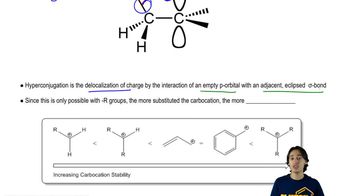
Carbocation Stability

Carbocation stability is a key factor in Sₙ1 reactions, as more stable carbocations are formed preferentially. Stability is influenced by factors such as the degree of substitution (tertiary > secondary > primary) and resonance effects. A stable carbocation can lead to rearrangements, where the molecule shifts to form a more stable structure, impacting the final product. Recognizing these stability patterns is essential for predicting reaction pathways.
Recommended video:
Guided course
05:58
Determining Carbocation Stability

Rearrangement Mechanisms

Rearrangement mechanisms in organic chemistry refer to the structural changes that occur during a reaction, often to form more stable intermediates. In Sₙ1 reactions, a carbocation may undergo hydride or alkyl shifts to achieve greater stability. These rearrangements can significantly alter the product distribution and are critical for understanding the overall reaction mechanism. Familiarity with common rearrangement types helps in predicting the outcomes of Sₙ1 reactions.
Recommended video:
Guided course
06:08
Definition of Claisen Rearrangement