Ch. 12 - Substitution and Elimination: Reactions of Haloalkanes
Mullins - Organic Chemistry: A Learner Centered Approach 1st Edition
Mullins1st EditionOrganic Chemistry: A Learner Centered ApproachISBN: 9780137566471Not the one you use?Change textbook
Chapter 11, Problem 33a

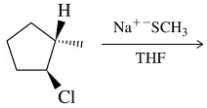
Predict the product of the following substitution reactions, making sure to note whether a rearrangement should occur.
(a)

Verified step by step guidance
1
Step 1: Identify the type of substitution reaction. The presence of Na⁺SCH₃ indicates a nucleophilic substitution reaction, likely SN2 due to the strong nucleophile (SCH₃⁻) and polar aprotic solvent (THF).
Step 2: Analyze the substrate. The substrate is a cyclopentane ring with a secondary alkyl chloride. Secondary alkyl halides can undergo SN2 reactions, especially in polar aprotic solvents.
Step 3: Consider stereochemistry. SN2 reactions proceed via a backside attack, leading to an inversion of configuration at the carbon where substitution occurs. The chlorine is leaving, and SCH₃⁻ will replace it with inversion of stereochemistry.
Step 4: Check for rearrangements. Rearrangements are unlikely in SN2 reactions because the mechanism involves a single concerted step without carbocation intermediates.
Step 5: Predict the product. The product will be a cyclopentane ring with SCH₃ replacing the Cl group, and the stereochemistry at the substitution site will be inverted relative to the starting material.

Verified video answer for a similar problem:

This video solution was recommended by our tutors as helpful for the problem above.
Was this helpful?

Key Concepts

Here are the essential concepts you must grasp in order to answer the question correctly.

Nucleophilic Substitution Reactions

Nucleophilic substitution reactions involve the replacement of a leaving group (like Cl) by a nucleophile (like SCH3). The mechanism can be either SN1 or SN2, depending on the substrate structure and reaction conditions. In this case, the cyclic structure suggests that the reaction may proceed via an SN2 mechanism due to steric considerations.
Recommended video:
Guided course
01:47
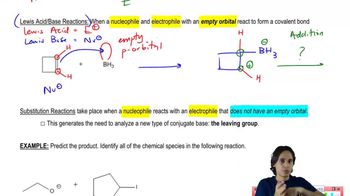
Nucleophiles and Electrophiles can react in Substitution Reactions.

Rearrangement in Organic Reactions

Rearrangement refers to the structural reorganization of a molecule during a reaction, which can lead to different products. In nucleophilic substitution reactions, rearrangements can occur if a more stable carbocation can be formed. Understanding when and how rearrangements happen is crucial for predicting the final product of the reaction.
Recommended video:
Guided course
06:08
Definition of Claisen Rearrangement

Solvent Effects in Organic Reactions

The choice of solvent can significantly influence the outcome of organic reactions. In this case, THF (tetrahydrofuran) is a polar aprotic solvent that stabilizes the nucleophile and facilitates the reaction. The solvent's properties can affect the reaction rate and the mechanism, making it an important factor to consider in predicting the product.
Recommended video:
Guided course
02:26
General format of reactions and how to interpret solvents.