Ch. 11 - Properties and Synthesis of Alkyl Halides: Radical Reactions
Mullins - Organic Chemistry: A Learner Centered Approach 1st Edition
Mullins1st EditionOrganic Chemistry: A Learner Centered ApproachISBN: 9780137566471Not the one you use?Change textbook
Chapter 10, Problem 55

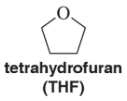
The solvent tetrahydrofuran (THF) is often sold with a small amount of BHT added. Provide a mechanism that explains why this might be so.

Verified step by step guidance
1
Tetrahydrofuran (THF) is a cyclic ether that is prone to oxidation when exposed to air, forming peroxides. These peroxides can be hazardous as they are potentially explosive.
Butylated hydroxytoluene (BHT) is a common antioxidant added to THF to prevent the formation of peroxides. BHT acts by donating a hydrogen atom to free radicals, thus terminating the radical chain reaction that leads to peroxide formation.
The mechanism begins with the initiation step where THF is exposed to oxygen, forming a THF radical and a superoxide radical.
In the propagation step, the THF radical reacts with oxygen to form a peroxide radical. This peroxide radical can further react with THF to form more radicals, continuing the chain reaction.
BHT intervenes in the chain reaction by donating a hydrogen atom to the peroxide radical, converting it into a non-radical species and thus stopping the propagation of the radical chain reaction.

Verified video answer for a similar problem:

This video solution was recommended by our tutors as helpful for the problem above.
Video duration:
14m
Was this helpful?

Key Concepts

Here are the essential concepts you must grasp in order to answer the question correctly.

Tetrahydrofuran (THF)

Tetrahydrofuran (THF) is a cyclic ether commonly used as a solvent in organic chemistry due to its ability to dissolve a wide range of polar and nonpolar compounds. Its structure features a five-membered ring with four carbon atoms and one oxygen atom, which contributes to its unique properties, including low viscosity and high dielectric constant. Understanding THF's reactivity and stability is crucial for grasping why additives like BHT are used.
Recommended video:
Guided course
01:16
Identification of polarity in solvents

BHT (Butylated Hydroxytoluene)

BHT, or Butylated Hydroxytoluene, is a synthetic antioxidant commonly added to various products to prevent oxidation. In the context of THF, BHT helps to inhibit the degradation of the solvent by scavenging free radicals that can form during storage or use. This preservation is essential for maintaining the solvent's effectiveness and preventing unwanted side reactions in chemical processes.
Recommended video:
Guided course
05:49
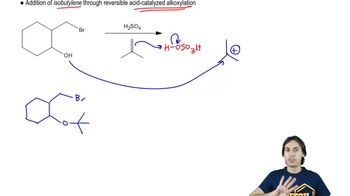
Mechanism of t-Butyl Ether Protecting Groups.

Free Radical Mechanism

The free radical mechanism involves the formation and reaction of free radicals, which are highly reactive species with unpaired electrons. In the presence of heat or light, THF can undergo autoxidation, leading to the generation of free radicals that can further react with the solvent, causing degradation. Understanding this mechanism is vital for explaining why BHT is added to THF, as it acts to stabilize the solvent by neutralizing these reactive intermediates.
Recommended video:
Guided course
03:28
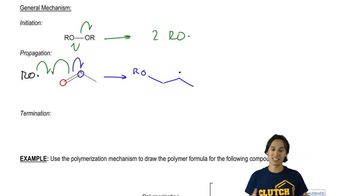
The mechanism of Radical Polymerization.