Ch. 11 - Properties and Synthesis of Alkyl Halides: Radical Reactions
Mullins - Organic Chemistry: A Learner Centered Approach 1st Edition
Mullins1st EditionOrganic Chemistry: A Learner Centered ApproachISBN: 9780137566471Not the one you use?Change textbook
Chapter 10, Problem 52b

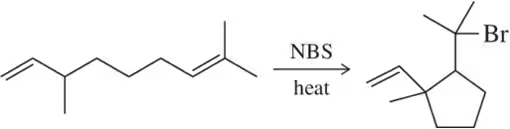
Provide the mechanism of the radical reactions shown.
(b) Chemical reaction showing allylic bromination with NBS and heat, resulting in bromine addition to a cyclohexene structure.

Verified step by step guidance
1
Identify the type of radical reaction involved. Radical reactions typically include initiation, propagation, and termination steps.
Initiation: Determine the source of radicals. This often involves the homolytic cleavage of a bond, usually facilitated by heat or light, to generate two radicals. Represent this step using curved single-headed arrows to show the movement of a single electron.
Propagation: Identify the steps where radicals react with stable molecules to form new radicals. This usually involves two main steps: the radical reacts with a molecule to form a new radical and a new molecule, and then this new radical reacts further to propagate the chain reaction. Use single-headed arrows to show electron movement.
Termination: Determine how the radicals are removed from the reaction mixture. This can occur when two radicals combine to form a stable molecule, effectively ending the chain reaction. Again, use single-headed arrows to depict the electron pairing.
Draw the complete mechanism, ensuring that all steps are balanced in terms of electron count and that the movement of electrons is clearly indicated with appropriate arrows. Verify that the mechanism is consistent with the principles of radical stability and reactivity.

Verified video answer for a similar problem:

This video solution was recommended by our tutors as helpful for the problem above.
Video duration:
10m
Was this helpful?

Key Concepts

Here are the essential concepts you must grasp in order to answer the question correctly.

Radical Formation

Radical formation involves the homolytic cleavage of a covalent bond, resulting in two radicals, each possessing an unpaired electron. This process is typically initiated by heat or light, which provides the energy needed to break the bond. Understanding how radicals are generated is crucial for predicting the behavior and reactivity in radical reactions.
Recommended video:
1:30
Radical Polymerization Concept 4

Propagation Steps

Propagation steps in radical reactions involve the radicals reacting with stable molecules to form new radicals, perpetuating the reaction cycle. These steps are essential for the continuation of the radical chain reaction, where the radical species generated in one step react further to produce additional radicals, driving the reaction forward until termination.
Recommended video:
1:05
Step-Growth Polymers Concept 1

Termination Steps

Termination steps occur when two radical species combine to form a stable, non-radical product, effectively ending the radical chain reaction. This can happen through various pathways, such as radical recombination or disproportionation. Understanding termination is key to controlling radical reactions and preventing unwanted side reactions or polymerization.
Recommended video:
1:05
Step-Growth Polymers Concept 1