Textbook Question
The following ethers are ranked according to their ability to form explosive peroxides. Explain this ranking based on your knowledge of the reaction mechanism.
2
views

 Mullins 1st EditionCh. 11 - Properties and Synthesis of Alkyl Halides: Radical ReactionsProblem 57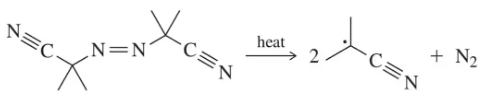
 Verified step by step guidance
 03:49
03:49
 04:32
04:32 01:46
01:46The following ethers are ranked according to their ability to form explosive peroxides. Explain this ranking based on your knowledge of the reaction mechanism.
Tributyltin hydride (Bu3SnH) is often used as a 'radical carrier' in radical reactions. Which bond would you expect to be weaker, Sn–H or C–H? How might this relate to radical stability? Explain your answer.
Haloalkanes can be reduced to alkanes using radical reactions involving Bu₃SnH and a catalytic amount of AIBN. Suggest a mechanism for this reaction. [Pay close attention to the bonds formed and broken in developing your mechanism.]
The solvent tetrahydrofuran (THF) is often sold with a small amount of BHT added. Provide a mechanism that explains why this might be so.
If a small amount of a moderately nonpolar poisonous compound was added to a pond, why would it be safer to drink the water than it would be to eat the fish that live there?
Cyclizations can be carried out under radical conditions involving Bu₃SnH and a catalytic amount of AIBN. Suggest a mechanism for this reaction. [Pay close attention to the bonds formed and broken in developing your mechanism. It may be helpful to number the carbons.]