Textbook Question
Predict the major products of the following alkane halogenation reactions. [The number of products shown ignores the formation of racemic mixtures.]
(b)
1
views

 Mullins 1st EditionCh. 11 - Properties and Synthesis of Alkyl Halides: Radical ReactionsProblem 22c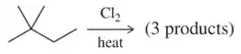
 Verified step by step guidance
 02:47
02:47
 03:28
03:28 05:09
05:09Predict the major products of the following alkane halogenation reactions. [The number of products shown ignores the formation of racemic mixtures.]
(b)
Can you make a 1° bromoalkane like (3-bromopropyl)cyclopentane using alkane halogenation? Why or why not?
Why is a 2° carbon radical more stable than a 1° carbon radical?
Predict the major products of the following alkane halogenation reactions. [The number of products shown ignores the formation of racemic mixtures.]
(d)
When (1R,3S)-1-tert-butyl-1,3-dimethylcyclopentane is halogenated, one stereoisomer is produced in excess.
(b) explain why this reaction did not produce an equal mixture of stereoisomers.
Suppose a 2-halobutane was needed for a synthetic sequence. Starting your synthesis with butane, would it be best to put a chlorine or bromine at that position? Explain.