Ch. 11 - Properties and Synthesis of Alkyl Halides: Radical Reactions
Mullins - Organic Chemistry: A Learner Centered Approach 1st Edition
Mullins1st EditionOrganic Chemistry: A Learner Centered ApproachISBN: 9780137566471Not the one you use?Change textbook
Chapter 10, Problem 22b

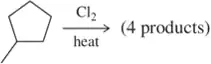
Predict the major products of the following alkane halogenation reactions. [The number of products shown ignores the formation of racemic mixtures.]
(b) Alkane reacts with Cl2 and heat, forming four products in free radical halogenation.

Verified step by step guidance
1
Identify the type of halogenation reaction: In alkane halogenation, a hydrogen atom in an alkane is replaced by a halogen atom, typically through a radical chain mechanism. The most common halogens used are chlorine (Cl2) and bromine (Br2).
Determine the type of alkane: Consider whether the alkane is linear, branched, or cyclic, as this will affect the stability of the intermediates and the regioselectivity of the reaction.
Consider the reactivity of the halogen: Chlorination is less selective and can lead to multiple products, while bromination is more selective and typically results in the formation of the most stable radical intermediate.
Identify the most stable radical intermediate: In bromination, the major product is usually formed via the most stable radical intermediate, which is often the tertiary radical due to its greater stability compared to secondary or primary radicals.
Predict the major product: Based on the stability of the radical intermediates, predict the major product of the halogenation reaction. For example, in bromination, the major product will be the one where the bromine atom is attached to the carbon that forms the most stable radical.

Verified video answer for a similar problem:

This video solution was recommended by our tutors as helpful for the problem above.
Was this helpful?

Key Concepts

Here are the essential concepts you must grasp in order to answer the question correctly.

Alkane Halogenation

Alkane halogenation is a reaction where a halogen, such as chlorine or bromine, is introduced to an alkane, resulting in the substitution of a hydrogen atom with a halogen atom. This reaction typically proceeds via a radical mechanism, initiated by heat or light, and involves the formation of reactive intermediates called free radicals.
Recommended video:
Guided course
02:47
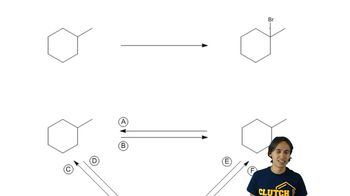
Functionalizing Alkanes

Radical Mechanism

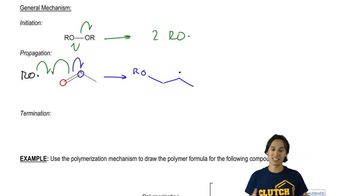
The radical mechanism in alkane halogenation involves three main steps: initiation, propagation, and termination. Initiation generates radicals, usually by homolytic cleavage of the halogen molecule. Propagation involves the reaction of radicals with alkanes to form new radicals, while termination occurs when radicals combine to form stable products, ending the chain reaction.
Recommended video:
Guided course
03:28
The mechanism of Radical Polymerization.

Regioselectivity in Halogenation

Regioselectivity refers to the preference for the formation of one constitutional isomer over others in a chemical reaction. In alkane halogenation, the major product is often determined by the stability of the intermediate radicals, with tertiary radicals being more stable than secondary, which are more stable than primary. This stability influences the site of halogen substitution, favoring more substituted carbon atoms.
Recommended video:
Guided course
03:45
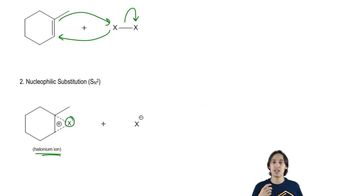
Halogenation Mechanism