Ch. 11 - Properties and Synthesis of Alkyl Halides: Radical Reactions
Mullins - Organic Chemistry: A Learner Centered Approach 1st Edition
Mullins1st EditionOrganic Chemistry: A Learner Centered ApproachISBN: 9780137566471Not the one you use?Change textbook
Chapter 10, Problem 24a

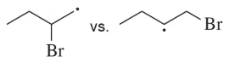
Why is a 2° carbon radical more stable than a 1° carbon radical?

Verified step by step guidance
1
Understand the concept of radical stability: In organic chemistry, radicals are atoms or molecules that have unpaired electrons. The stability of a radical is influenced by the number of alkyl groups attached to the carbon bearing the unpaired electron.
Identify the radicals: In the image, the first structure is a 2° (secondary) carbon radical, where the carbon with the unpaired electron is attached to two other carbon atoms. The second structure is a 1° (primary) carbon radical, where the carbon with the unpaired electron is attached to only one other carbon atom.
Consider hyperconjugation: Hyperconjugation is a stabilizing interaction that occurs when electrons in σ-bonds (typically C-H or C-C) adjacent to the radical center can delocalize into the empty p-orbital of the radical. A 2° carbon radical has more neighboring C-H bonds available for hyperconjugation compared to a 1° carbon radical, leading to greater stability.
Evaluate inductive effects: Alkyl groups can donate electron density through inductive effects, stabilizing the radical. A 2° carbon radical has more alkyl groups donating electron density compared to a 1° carbon radical, enhancing its stability.
Summarize the stability factors: The increased stability of a 2° carbon radical over a 1° carbon radical is due to the combined effects of hyperconjugation and inductive effects, which provide greater electron delocalization and electron density donation, respectively.

Verified video answer for a similar problem:

This video solution was recommended by our tutors as helpful for the problem above.
Was this helpful?

Key Concepts

Here are the essential concepts you must grasp in order to answer the question correctly.

Radical Stability

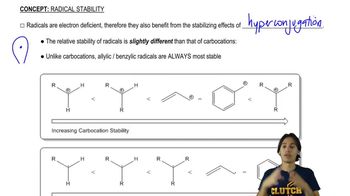
Radical stability refers to the relative stability of carbon radicals, which are species with an unpaired electron. The stability of these radicals is influenced by the degree of substitution on the carbon atom bearing the radical. Generally, tertiary (3°) radicals are more stable than secondary (2°) radicals, which in turn are more stable than primary (1°) radicals due to hyperconjugation and inductive effects from surrounding alkyl groups.
Recommended video:
Guided course
03:43
The radical stability trend.

Hyperconjugation

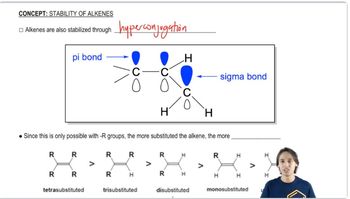
Hyperconjugation is a stabilizing interaction that occurs when the electrons in a sigma bond (usually C-H or C-C) interact with an adjacent empty p-orbital or radical. In the case of a 2° carbon radical, the presence of two alkyl groups allows for more hyperconjugative interactions compared to a 1° radical, which only has one. This additional stabilization contributes to the greater stability of the 2° radical.
Recommended video:
Guided course
04:28
Understanding trends of alkene stability.

Inductive Effect

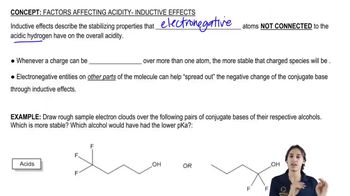
The inductive effect is the electron-donating or withdrawing effect transmitted through sigma bonds in a molecule. Alkyl groups are electron-donating, which can help stabilize a radical by dispersing the unpaired electron's charge. In a 2° carbon radical, the two adjacent alkyl groups provide a stronger inductive effect than the single alkyl group in a 1° radical, enhancing the overall stability of the 2° radical.
Recommended video:
Guided course
01:47
Understanding the Inductive Effect.