Ch. 10 - Alkynes: Electrophilic Addition and Redox Reactions
Mullins - Organic Chemistry: A Learner Centered Approach 1st Edition
Mullins1st EditionOrganic Chemistry: A Learner Centered ApproachISBN: 9780137566471Not the one you use?Change textbook
Chapter 9, Problem 17b

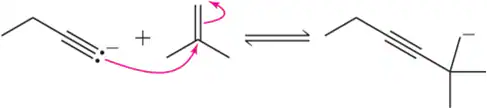
Estimate the Keq for the following reactions based on the stability of the anions involved.
(b) Chemical reaction diagram showing electron movement and equilibrium between reactants and products.

Verified step by step guidance
1
Step 1: Analyze the reaction provided. The reaction involves the transfer of a proton and the formation of an anion. The stability of the anions formed will determine the equilibrium constant (K_eq).
Step 2: Identify the anions involved in the reaction. On the left side, the anion is formed from a terminal alkyne, which results in an acetylide ion (C≡C⁻). On the right side, the anion is formed from a cyclopentadiene, which results in a cyclopentadienyl anion.
Step 3: Evaluate the stability of the acetylide ion (C≡C⁻). The acetylide ion is stabilized by the sp hybridization of the carbon atom, which makes it relatively stable due to the high electronegativity of sp-hybridized carbons.
Step 4: Evaluate the stability of the cyclopentadienyl anion. The cyclopentadienyl anion is aromatic, as it follows Huckel's rule (4n+2 π electrons, where n=1). Aromaticity provides significant stabilization, making this anion highly stable.
Step 5: Compare the stability of the two anions. Since the cyclopentadienyl anion is aromatic and more stable than the acetylide ion, the equilibrium will favor the formation of the cyclopentadienyl anion. Thus, K_eq will be greater than 1, favoring the products.

Verified video answer for a similar problem:

This video solution was recommended by our tutors as helpful for the problem above.
Video duration:
6m
Was this helpful?

Key Concepts

Here are the essential concepts you must grasp in order to answer the question correctly.

Equilibrium Constant (K_eq)

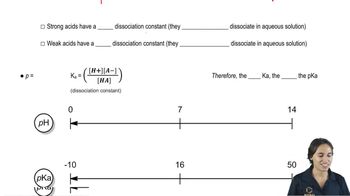
The equilibrium constant (K_eq) quantifies the ratio of the concentrations of products to reactants at equilibrium for a given reaction. It is a crucial parameter in understanding the extent of a reaction; a K_eq greater than 1 indicates that products are favored, while a K_eq less than 1 suggests that reactants are favored. The value of K_eq is influenced by the stability of the species involved, particularly the anions in this case.
Recommended video:
Guided course
02:19
The relationship between equilibrium constant and pKa.

Stability of Anions

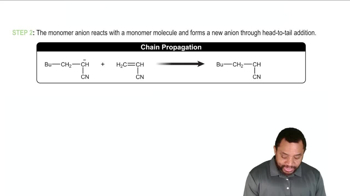
The stability of anions is a key factor in determining the favorability of a reaction. More stable anions are less reactive and are favored in equilibrium, as they can better accommodate negative charge. Factors influencing anion stability include electronegativity, resonance, and inductive effects. Understanding these factors helps predict which side of the reaction will be favored based on the anions formed.
Recommended video:
0:53
Anionic Polymerization Concept 3

Resonance Structures

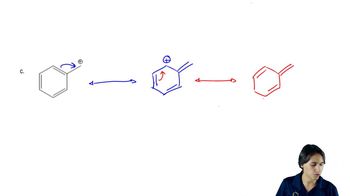
Resonance structures are different ways of drawing a molecule that represent the same compound, highlighting the delocalization of electrons. In the context of anions, resonance can significantly enhance stability by allowing the negative charge to be spread over multiple atoms. This delocalization lowers the energy of the anion, making it more stable and thus influencing the equilibrium position of the reaction.
Recommended video:
Guided course
03:04
Drawing Resonance Structures