Ch. 10 - Alkynes: Electrophilic Addition and Redox Reactions
Mullins - Organic Chemistry: A Learner Centered Approach 1st Edition
Mullins1st EditionOrganic Chemistry: A Learner Centered ApproachISBN: 9780137566471Not the one you use?Change textbook
Chapter 9, Problem 18

Draw a transition state for the following substitution reaction.
Chemical equation illustrating a substitution reaction with reactants and products, including a transition state diagram.

Verified step by step guidance
1
Identify the type of substitution reaction: This is an SN2 reaction, as the nucleophile (acetylide ion, H₃C―C≡C⁻) directly attacks the electrophilic carbon in the methyl chloride (H₃C―Cl), leading to a single-step mechanism.
Understand the transition state: In an SN2 reaction, the transition state involves simultaneous bond formation and bond breaking. The nucleophile forms a new bond with the electrophilic carbon while the leaving group (Cl⁻) begins to detach.
Draw the structure of the transition state: Represent the central carbon atom of the methyl chloride as partially bonded to both the nucleophile (H₃C―C≡C⁻) and the leaving group (Cl⁻). Use dashed lines to indicate partial bonds in the transition state.
Include the geometry of the transition state: The central carbon in the transition state adopts a trigonal bipyramidal geometry, with the nucleophile and leaving group positioned opposite each other (anti-periplanar) to minimize steric hindrance.
Label charges and partial bonds: Indicate the negative charge on the acetylide ion (H₃C―C≡C⁻) and the partial negative charge on the leaving group (Cl⁻). Ensure the transition state reflects the simultaneous bond-making and bond-breaking process.

Verified video answer for a similar problem:

This video solution was recommended by our tutors as helpful for the problem above.
Video duration:
4m
Was this helpful?

Key Concepts

Here are the essential concepts you must grasp in order to answer the question correctly.

Transition State

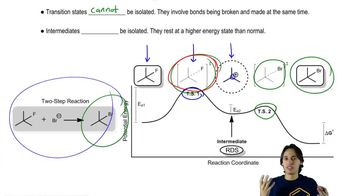
A transition state is a high-energy, unstable arrangement of atoms that occurs during a chemical reaction. It represents the point at which reactants are transformed into products, and it cannot be isolated. In the context of a substitution reaction, the transition state is crucial for understanding the mechanism and energy changes involved as the nucleophile attacks the electrophile.
Recommended video:
Guided course
06:55
Intermediates vs. Transition States

Nucleophilic Substitution

Nucleophilic substitution is a fundamental reaction in organic chemistry where a nucleophile replaces a leaving group in a molecule. In this case, the acetylide ion (H₃C―C ≡ C⁻) acts as the nucleophile, attacking the carbon atom bonded to chlorine in H₃C―Cl. Understanding the mechanism of this reaction, whether it follows an SN1 or SN2 pathway, is essential for predicting the structure of the transition state.
Recommended video:
Guided course
01:47
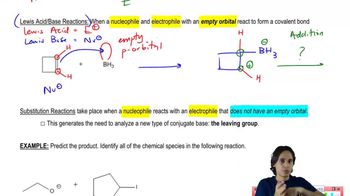
Nucleophiles and Electrophiles can react in Substitution Reactions.

Reaction Mechanism

A reaction mechanism describes the step-by-step process by which reactants are converted into products, detailing the bonds that are broken and formed. In substitution reactions, the mechanism can influence the stereochemistry and kinetics of the reaction. Analyzing the mechanism helps in visualizing the transition state and understanding the factors that affect the reaction rate and outcome.
Recommended video:
Guided course
02:16
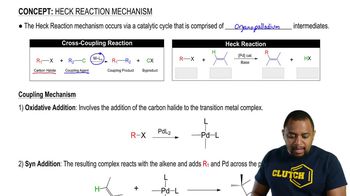
Heck Reaction Mechanism