Ch. 10 - Alkynes: Electrophilic Addition and Redox Reactions
Mullins - Organic Chemistry: A Learner Centered Approach 1st Edition
Mullins1st EditionOrganic Chemistry: A Learner Centered ApproachISBN: 9780137566471Not the one you use?Change textbook
Chapter 9, Problem 15c

Calculate for the following acid–base reactions. Which is the best base to use to deprotonate acetylene and make the acetylide anion?
(c)

Verified step by step guidance
1
Step 1: Understand the problem. The goal is to determine the best base to deprotonate acetylene (H-C≡C-H) and form the acetylide anion (C≡C⁻). This involves comparing the acid-base properties of the reactants and products.
Step 2: Analyze the reaction provided. The reaction shows phenoxide ion (C₆H₅O⁻) acting as a base to deprotonate acetylene, forming phenol (C₆H₅OH) and the acetylide anion. The pKa of phenol is given as 10.
Step 3: Use the pKa values to assess the acid-base equilibrium. Acetylene has a pKa of approximately 25, which is much higher than phenol's pKa of 10. A lower pKa indicates a stronger acid, so phenol is a stronger acid than acetylene.
Step 4: Evaluate the equilibrium direction. Since phenol is a stronger acid than acetylene, the equilibrium will favor the formation of phenol and the acetylide anion. This suggests that phenoxide ion (C₆H₅O⁻) is a suitable base for deprotonating acetylene.
Step 5: Consider other bases. To determine the 'best' base, compare the basicity of phenoxide ion with other potential bases, such as hydroxide ion (OH⁻) or amide ion (NH₂⁻). Stronger bases (with conjugate acids having higher pKa values) are more effective at deprotonating acetylene.

Verified video answer for a similar problem:

This video solution was recommended by our tutors as helpful for the problem above.
Was this helpful?

Key Concepts

Here are the essential concepts you must grasp in order to answer the question correctly.

Acidity and pKa

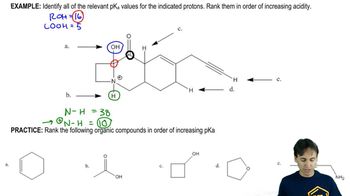
Acidity is a measure of how readily a compound donates protons (H+ ions) in a reaction. The pKa value quantifies this tendency; lower pKa values indicate stronger acids. In the context of the question, understanding the pKa of acetylene (approximately 25) and the phenoxide ion (pKa around 10) is crucial for determining which base can effectively deprotonate acetylene to form the acetylide anion.
Recommended video:
Guided course
07:45
Identifying pKa values

Acetylide Anion Formation

The acetylide anion is formed when acetylene (C≡C-H) loses a proton. This reaction is significant in organic synthesis, as acetylide anions are strong nucleophiles that can react with electrophiles. Identifying a suitable base to deprotonate acetylene involves selecting a base that is stronger than the conjugate acid formed, which in this case is the phenol (pKa 10).
Recommended video:
0:58
Anionic Polymerization Concept 1

Base Strength and Conjugate Acids

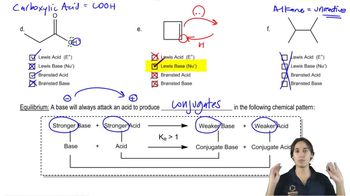
The strength of a base is determined by its ability to accept protons, which is inversely related to the strength of its conjugate acid. A strong base will have a weak conjugate acid, making it effective for deprotonation. In this scenario, the base used must have a pKa greater than that of the conjugate acid formed (phenol) to ensure that the reaction proceeds favorably towards the formation of the acetylide anion.
Recommended video:
Guided course
02:11
Equilibrium constant and conjugates.