Ch. 9 - Substitution and Elimination Reactions of Alkyl Halides
Bruice - Organic Chemistry 8th Edition
Bruice8th EditionOrganic ChemistryISBN: 9780135213711Not the one you use?Change textbook
Chapter 10, Problem 69a,b

Which member in each pair in [PROBLEM 9-68] is a better leaving group?
a. H2O or HO
b. NH3 or H2O

Verified step by step guidance
1
Step 1: Understand the concept of a leaving group. A leaving group is an atom or group of atoms that can depart with a pair of electrons in a substitution or elimination reaction. A good leaving group is typically weakly basic and stable after leaving.
Step 2: Analyze the first pair (H2O vs. HO−). Compare their basicity. HO− (hydroxide ion) is a strong base, while H2O (water) is a neutral molecule and much less basic. Since weaker bases are better leaving groups, H2O is expected to be the better leaving group.
Step 3: Consider the stability of the leaving group after departure for the first pair. H2O becomes a neutral molecule after leaving, which is stable. HO−, on the other hand, remains a charged species (a strong base), making it less stable and a poorer leaving group.
Step 4: Analyze the second pair (NH3 vs. H2O). Compare their basicity. NH3 (ammonia) is a weak base, but H2O is even less basic. Since H2O is less basic, it is expected to be the better leaving group.
Step 5: Consider the stability of the leaving group after departure for the second pair. H2O, as a neutral molecule, is more stable than NH3, which is also neutral but slightly more basic. This further supports that H2O is the better leaving group in this pair.

Verified video answer for a similar problem:

This video solution was recommended by our tutors as helpful for the problem above.
Video duration:
5m
Was this helpful?

Key Concepts

Here are the essential concepts you must grasp in order to answer the question correctly.

Leaving Groups

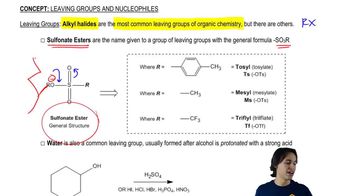
Leaving groups are atoms or groups of atoms that can depart from a molecule during a chemical reaction, typically in nucleophilic substitution or elimination reactions. A good leaving group is stable after departure, often being a weak base. Common examples include halides and water, while strong bases like hydroxide (HO−) are generally poor leaving groups.
Recommended video:
Guided course
07:22
The 3 important leaving groups to know.

Basicity and Stability

The basicity of a leaving group is inversely related to its ability to leave; weaker bases are better leaving groups. For instance, H2O is a neutral molecule and a weak base, making it a better leaving group than HO−, which is a strong base. Similarly, the stability of the leaving group after it departs influences its effectiveness in reactions.
Recommended video:
Guided course
03:43
The radical stability trend.

Comparative Analysis of Leaving Groups

When comparing leaving groups, one must assess their relative stabilities and basicities. In the pairs given, H2O is a better leaving group than HO− due to its neutral charge and lower basicity. In the second pair, H2O is also a better leaving group than NH3, as NH3 is a stronger base and less stable as a leaving group.
Recommended video:
Guided course
07:22
The 3 important leaving groups to know.