Ch. 9 - Substitution and Elimination Reactions of Alkyl Halides
Bruice - Organic Chemistry 8th Edition
Bruice8th EditionOrganic ChemistryISBN: 9780135213711Not the one you use?Change textbook
Chapter 10, Problem 70a,b

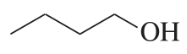
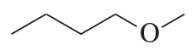
What nucleophiles would form the following compounds as a result of reacting with 1-iodobutane?
a.
b.

Verified step by step guidance
1
Step 1: Identify the starting material, 1-iodobutane, which is a primary alkyl halide. This compound is reactive in nucleophilic substitution reactions due to the presence of the iodine atom, which is a good leaving group.
Step 2: For compound (a), 1-butanol (C4H9OH), the nucleophile required is hydroxide ion (OH⁻). The reaction proceeds via an SN2 mechanism, where the hydroxide ion attacks the carbon bonded to iodine, displacing the iodine atom.
Step 3: For compound (b), butyl methyl ether (C4H9OCH3), the nucleophile required is methoxide ion (CH3O⁻). Similar to the first case, the reaction proceeds via an SN2 mechanism, where the methoxide ion attacks the carbon bonded to iodine, displacing the iodine atom.
Step 4: Ensure the reaction conditions are suitable for SN2 mechanisms. These typically include a polar aprotic solvent (e.g., acetone or DMSO) to stabilize the nucleophile and promote the substitution reaction.
Step 5: Verify the products formed. For (a), the hydroxide ion replaces iodine to form 1-butanol. For (b), the methoxide ion replaces iodine to form butyl methyl ether. Both reactions are examples of nucleophilic substitution.

Verified video answer for a similar problem:

This video solution was recommended by our tutors as helpful for the problem above.
Video duration:
2m
Was this helpful?

Key Concepts

Here are the essential concepts you must grasp in order to answer the question correctly.

Nucleophiles

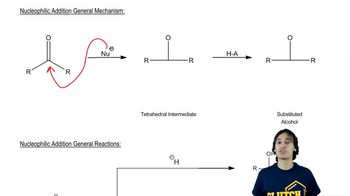
Nucleophiles are species that donate an electron pair to form a chemical bond in a reaction. They are typically negatively charged or neutral molecules with lone pairs of electrons. In organic chemistry, common nucleophiles include hydroxide ions, alkoxides, and amines, which can attack electrophilic centers in substrates like alkyl halides.
Recommended video:
Guided course
08:27
Nucleophilic Addition

Substitution Reactions

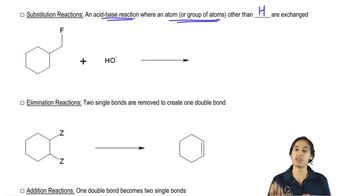
Substitution reactions involve the replacement of one functional group in a molecule with another. In the context of 1-iodobutane, these reactions can occur via two main mechanisms: SN1 and SN2. The choice of mechanism depends on factors such as the structure of the substrate and the nature of the nucleophile, influencing the reaction pathway and product formation.
Recommended video:
Guided course
01:34
Recognizing Substitution Reactions.

1-Iodobutane Reactivity

1-Iodobutane is a primary alkyl halide, which makes it a good substrate for nucleophilic substitution reactions. Its reactivity is influenced by the leaving group ability of iodine and the steric accessibility of the carbon atom bonded to the iodine. Understanding the structure and reactivity of 1-iodobutane is crucial for predicting which nucleophiles will effectively react with it to form new compounds.
Recommended video:
Guided course
01:17
Reactivity of Molecules