Ch. 9 - Substitution and Elimination Reactions of Alkyl Halides
Bruice - Organic Chemistry 8th Edition
Bruice8th EditionOrganic ChemistryISBN: 9780135213711Not the one you use?Change textbook
Chapter 10, Problem 70h

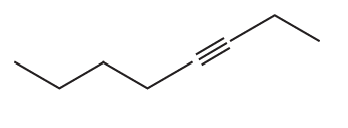
What nucleophiles would form the following compounds as a result of reacting with 1-iodobutane?
h. Chemical structures illustrating nucleophiles reacting with 1-iodobutane in an SN2 reaction context.

Verified step by step guidance
1
Step 1: Analyze the given compound structure. The compound shown contains a nitrile group (-C≡N) attached to a butane chain. This indicates that the nucleophile used in the reaction must have introduced the nitrile group.
Step 2: Recall the mechanism of nucleophilic substitution reactions. 1-Iodobutane is a primary alkyl halide, which typically undergoes SN2 reactions. In an SN2 reaction, the nucleophile attacks the carbon bonded to the leaving group (iodine) in a single step, displacing the leaving group.
Step 3: Identify the nucleophile that can introduce the nitrile group. The nucleophile in this case would be the cyanide ion (CN⁻), as it contains the nitrile group and is a strong nucleophile capable of participating in an SN2 reaction.
Step 4: Write the reaction mechanism. The cyanide ion (CN⁻) attacks the carbon atom bonded to iodine in 1-iodobutane, forming a new bond between the carbon and the cyanide group while displacing iodine as the leaving group.
Step 5: Summarize the reaction. The nucleophile required to form the given compound from 1-iodobutane is the cyanide ion (CN⁻). The reaction proceeds via an SN2 mechanism, resulting in the substitution of the iodine atom with the nitrile group.

Verified video answer for a similar problem:

This video solution was recommended by our tutors as helpful for the problem above.
Video duration:
3m
Was this helpful?

Key Concepts

Here are the essential concepts you must grasp in order to answer the question correctly.

Nucleophiles

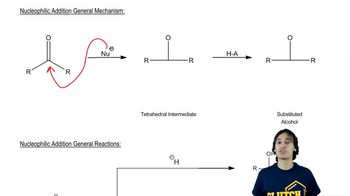
Nucleophiles are species that donate an electron pair to form a chemical bond in a reaction. They are typically negatively charged or neutral molecules with lone pairs of electrons. In the context of organic reactions, nucleophiles attack electrophiles, which are electron-deficient species. Common examples include hydroxide ions (OH⁻), alkoxides (RO⁻), and amines (RNH₂).
Recommended video:
Guided course
08:27
Nucleophilic Addition

SN2 Reaction Mechanism

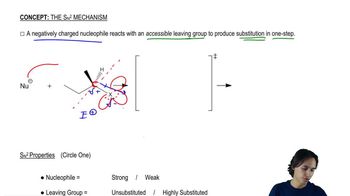
The SN2 (substitution nucleophilic bimolecular) reaction is a type of nucleophilic substitution where the nucleophile attacks the electrophile simultaneously as the leaving group departs. This mechanism involves a single concerted step, leading to the inversion of configuration at the carbon center. It is favored by primary and some secondary alkyl halides, such as 1-iodobutane, due to steric accessibility.
Recommended video:
Guided course
08:33
Drawing the SN2 Mechanism

Leaving Groups

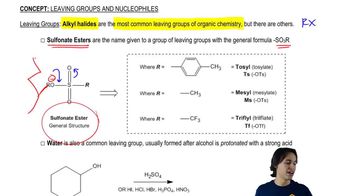
Leaving groups are atoms or groups that can depart from the parent molecule during a chemical reaction, allowing for the formation of new bonds. A good leaving group is typically stable after departure, which is often the case for halides like iodide (I⁻). In SN2 reactions, the quality of the leaving group significantly influences the reaction rate, with better leaving groups facilitating faster reactions.
Recommended video:
Guided course
07:22
The 3 important leaving groups to know.