Ch. 9 - Substitution and Elimination Reactions of Alkyl Halides
Bruice - Organic Chemistry 8th Edition
Bruice8th EditionOrganic ChemistryISBN: 9780135213711Not the one you use?Change textbook
Chapter 10, Problem 67d

What product is formed when 1-bromopropane reacts with each of the following nucleophiles?
d. HS

Verified step by step guidance
1
Step 1: Recognize the type of reaction. This is a nucleophilic substitution reaction where 1-bromopropane (an alkyl halide) reacts with HS⁻ (a nucleophile). Since 1-bromopropane is a primary alkyl halide, the reaction is likely to proceed via the SN2 mechanism.
Step 2: Understand the SN2 mechanism. In an SN2 reaction, the nucleophile attacks the electrophilic carbon (the carbon bonded to the bromine) directly from the opposite side of the leaving group, resulting in a single-step reaction.
Step 3: Identify the leaving group. Bromine (Br⁻) is the leaving group in this reaction. It will detach from the carbon atom as the nucleophile (HS⁻) forms a new bond with the carbon.
Step 4: Write the chemical equation for the reaction. The nucleophile HS⁻ attacks the carbon bonded to bromine in 1-bromopropane, displacing the bromine atom. The product formed will be propylthiol (CH₃CH₂CH₂SH).
Step 5: Consider stereochemistry. Since the SN2 mechanism involves a backside attack, if the carbon bonded to bromine were chiral, the product would exhibit inversion of configuration. However, in this case, 1-bromopropane does not have a chiral center, so stereochemistry is not a concern.

Verified video answer for a similar problem:

This video solution was recommended by our tutors as helpful for the problem above.
Video duration:
4m
Was this helpful?

Key Concepts

Here are the essential concepts you must grasp in order to answer the question correctly.

Nucleophilic Substitution

Nucleophilic substitution is a fundamental reaction in organic chemistry where a nucleophile attacks an electrophile, resulting in the replacement of a leaving group. In the case of 1-bromopropane, the bromine atom acts as the leaving group, and the nucleophile (HS−) replaces it, forming a new product. Understanding this mechanism is crucial for predicting the outcome of the reaction.
Recommended video:
Guided course
01:47
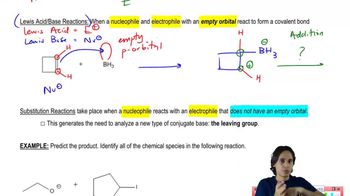
Nucleophiles and Electrophiles can react in Substitution Reactions.

Nucleophiles

Nucleophiles are species that donate an electron pair to form a chemical bond in a reaction. They are typically negatively charged or neutral molecules with lone pairs of electrons. In this question, HS− is a strong nucleophile due to its negative charge and ability to readily attack electrophilic centers, such as the carbon atom bonded to the bromine in 1-bromopropane.
Recommended video:
Guided course
08:27
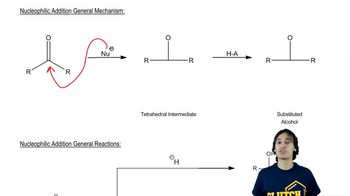
Nucleophilic Addition

Reaction Mechanism

The reaction mechanism describes the step-by-step process by which reactants are converted into products. For the reaction of 1-bromopropane with HS−, the mechanism can involve either an SN1 or SN2 pathway, depending on the conditions. Understanding these mechanisms helps predict the structure of the product formed, which in this case would be propanethiol (HS-CH2-CH2-CH3).
Recommended video:
Guided course
02:16
Heck Reaction Mechanism