Ch. 8 - Delocalized Electrons: Their Effect on Stability, pKa, and the Products of a Reaction • Aromaticity and Electronic Effects: An Introduction to the Reactions of Benzene
Bruice - Organic Chemistry 8th Edition
Bruice8th EditionOrganic ChemistryISBN: 9780135213711Not the one you use?Change textbook
Chapter 9, Problem 4c

Which species in each pair is more stable?
c.

Verified step by step guidance
1
Analyze the structures of the two species provided. Both species contain an oxygen atom with a negative charge (-O⁻) attached to a carbon chain. The difference lies in the substitution pattern of the alkene group.
Consider the concept of alkene stability. Alkenes are stabilized by hyperconjugation and inductive effects from alkyl groups attached to the double bond. More substituted alkenes are generally more stable due to increased hyperconjugation.
Examine the first species (CH₃CHCH=CH₂). The double bond is monosubstituted, meaning it has only one alkyl group (CH₃) attached to the double bond. This results in lower stability compared to more substituted alkenes.
Examine the second species (CH₃C=CHCH₃). The double bond is disubstituted, meaning it has two alkyl groups (CH₃ and CH₃) attached to the double bond. This increases stability due to greater hyperconjugation and inductive effects.
Conclude that the second species (CH₃C=CHCH₃) is more stable than the first species (CH₃CHCH=CH₂) because the double bond in the second species is more substituted, leading to increased stabilization.

Verified video answer for a similar problem:

This video solution was recommended by our tutors as helpful for the problem above.
Video duration:
1m
Was this helpful?

Key Concepts

Here are the essential concepts you must grasp in order to answer the question correctly.

Stability of Chemical Species

The stability of chemical species refers to their tendency to maintain their structure and resist change. Factors influencing stability include the energy of the species, resonance structures, and steric hindrance. More stable species typically have lower energy and are less reactive, making them less likely to undergo chemical transformations.
Recommended video:
3:11
Chemical Reactions of Phosphate Anhydrides Concept 1

Resonance Structures

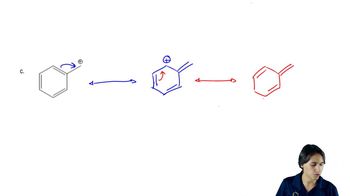
Resonance structures are different ways of drawing the same molecule that illustrate the delocalization of electrons. A molecule with multiple resonance forms can distribute its electron density more evenly, leading to increased stability. The actual structure of the molecule is a hybrid of these forms, and the more resonance forms a species has, the more stable it generally is.
Recommended video:
Guided course
03:04
Drawing Resonance Structures

Steric Hindrance

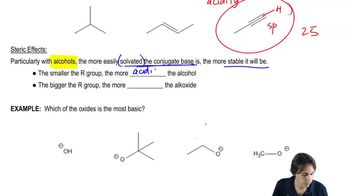
Steric hindrance occurs when atoms within a molecule are forced into close proximity, leading to repulsive interactions that can destabilize the structure. Larger groups or substituents can create steric strain, making a molecule less stable. Understanding steric effects is crucial for predicting the stability of different species, especially in organic compounds.
Recommended video:
Guided course
02:53
Understanding steric effects.