

Ch. 8 - Delocalized Electrons: Their Effect on Stability, pKa, and the Products of a Reaction • Aromaticity and Electronic Effects: An Introduction to the Reactions of Benzene
Bruice - Organic Chemistry 8th Edition
Bruice8th EditionOrganic ChemistryISBN: 9780135213711Not the one you use?Change textbook
Chapter 9, Problem 4a

Which species in each pair is more stable?
a.

Verified step by step guidance
1
Step 1: Analyze the stability of carbocations in the given species. Carbocation stability is influenced by factors such as hyperconjugation, resonance, and inductive effects.
Step 2: For the first species (CH3CH2C+CH2), the carbocation is located on a secondary carbon. Secondary carbocations are moderately stable due to hyperconjugation and inductive effects from adjacent alkyl groups.
Step 3: For the second species (CH3CH2CH=CH+CH2), the carbocation is located on an allylic position. Allylic carbocations are stabilized by resonance, as the positive charge can delocalize over the π-system of the double bond.
Step 4: Compare the two species. The allylic carbocation in the second species benefits from resonance stabilization, which generally makes it more stable than a secondary carbocation without resonance stabilization.
Step 5: Conclude that the second species (CH3CH2CH=CH+CH2) is more stable due to resonance stabilization, which is a stronger stabilizing factor compared to hyperconjugation and inductive effects in the first species.

Verified video answer for a similar problem:

This video solution was recommended by our tutors as helpful for the problem above.
Video duration:
1m
Was this helpful?

Key Concepts

Here are the essential concepts you must grasp in order to answer the question correctly.

Stability of Chemical Species

The stability of chemical species refers to their tendency to maintain their structure and resist change. Factors influencing stability include the energy of the species, resonance stabilization, and steric hindrance. More stable species typically have lower energy configurations and are less reactive, making them less likely to undergo chemical transformations.
Recommended video:
3:11
Chemical Reactions of Phosphate Anhydrides Concept 1

Resonance Structures

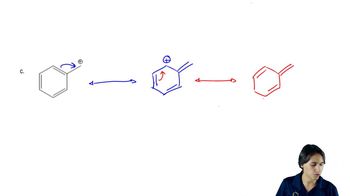
Resonance structures are different ways of drawing the same molecule that illustrate the delocalization of electrons. A molecule with multiple resonance structures can distribute its electron density more evenly, leading to increased stability. The actual structure of the molecule is a hybrid of these resonance forms, which helps in predicting reactivity and stability.
Recommended video:
Guided course
03:04
Drawing Resonance Structures

Steric Hindrance

Steric hindrance refers to the repulsion between atoms that occurs when they are brought close together, often due to the size of the groups attached to them. Increased steric hindrance can destabilize a molecule by making it less favorable for certain interactions or conformations. Understanding steric effects is crucial for predicting the stability of different chemical species.
Recommended video:
Guided course
02:53
Understanding steric effects.