Ch. 8 - Delocalized Electrons: Their Effect on Stability, pKa, and the Products of a Reaction • Aromaticity and Electronic Effects: An Introduction to the Reactions of Benzene
Bruice - Organic Chemistry 8th Edition
Bruice8th EditionOrganic ChemistryISBN: 9780135213711Not the one you use?Change textbook
Chapter 9, Problem 2

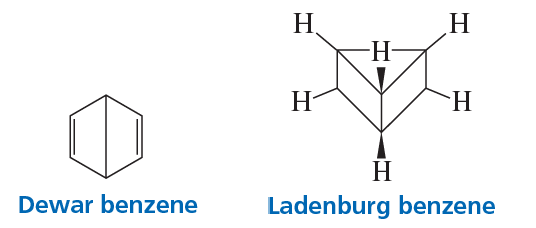
Between 1865 and 1890, other possible structures were proposed for benzene, such as those shown here. Considering what nineteenth-century chemists knew about benzene, which is a better proposal for benzene’s structure: Dewar benzene or Ladenburg benzene? Why?
Dewar benzene structure on the left, Ladenburg benzene structure on the right, with hydrogen atoms labeled.

Verified step by step guidance
1
Step 1: Begin by understanding the historical context of benzene's structure. Nineteenth-century chemists knew that benzene had the molecular formula C₆H₆ and exhibited unusual stability compared to other unsaturated compounds. This stability was difficult to explain using conventional structures.
Step 2: Analyze Dewar benzene's structure. Dewar benzene consists of two fused cyclobutene rings. While this structure accounts for the molecular formula, it does not explain benzene's exceptional stability or its lack of reactivity typical of alkenes. Additionally, Dewar benzene would have significant ring strain due to the cyclobutene rings.
Step 3: Examine Ladenburg benzene's structure. Ladenburg benzene is a prismane structure, which is highly strained due to its triangular prism shape. This strain would make the molecule highly reactive, contradicting the observed stability of benzene.
Step 4: Compare both structures to the actual properties of benzene. Benzene is known to undergo substitution reactions rather than addition reactions, indicating delocalized π-electrons rather than localized double bonds. Neither Dewar benzene nor Ladenburg benzene accounts for this delocalization.
Step 5: Conclude that neither Dewar benzene nor Ladenburg benzene is a better proposal for benzene’s structure. The actual structure of benzene, as proposed by Kekulé, involves a resonance hybrid of alternating single and double bonds, which better explains its stability and chemical behavior.

Verified video answer for a similar problem:

This video solution was recommended by our tutors as helpful for the problem above.
Was this helpful?

Key Concepts

Here are the essential concepts you must grasp in order to answer the question correctly.

Resonance Theory

Resonance theory explains that certain molecules can be represented by multiple valid Lewis structures, known as resonance structures. For benzene, this means that its actual structure is a hybrid of these forms, leading to equal bond lengths and strengths, which are intermediate between single and double bonds. This concept is crucial for understanding why traditional structures like Dewar and Ladenburg benzene may not accurately represent benzene's true nature.
Recommended video:
Guided course
06:27
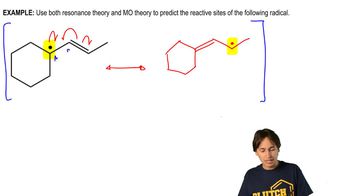
Explaining Resonance through MO Theory

Aromaticity

Aromaticity is a property of cyclic compounds that exhibit enhanced stability due to delocalized π electrons. For a compound to be aromatic, it must follow Huckel's rule, which states that it should have (4n + 2) π electrons. Benzene is the prototypical aromatic compound, and understanding this concept helps evaluate the proposed structures, as both Dewar and Ladenburg benzene deviate from the classic aromatic characteristics.
Recommended video:
Guided course
08:19
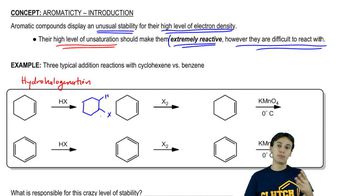
Intro to Aromaticity

Historical Context of Chemical Structures

The historical context of chemical structures involves understanding the scientific knowledge and theories available to chemists in the 19th century. During this period, chemists were exploring the nature of chemical bonding and molecular structure, leading to various proposals for benzene's structure. Recognizing the limitations and prevailing theories of the time is essential for assessing the validity of Dewar and Ladenburg's proposals in relation to benzene's actual structure.
Recommended video:
3:11
Chemical Reactions of Phosphate Anhydrides Concept 1