Ch. 7 - The Reactions of Alkynes • An Introduction to Multistep Synthesis
Bruice - Organic Chemistry 8th Edition
Bruice8th EditionOrganic ChemistryISBN: 9780135213711Not the one you use?Change textbook
Chapter 8, Problem 15c

Which alkyne should be used for the synthesis of each of the following ketones?
c.

Verified step by step guidance
1
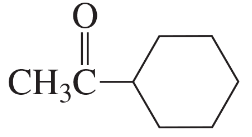
Step 1: Analyze the target ketone structure. The given ketone has a methyl group (CH₃) attached to the carbonyl group (C=O), and the other side of the carbonyl group is bonded to a cyclohexyl group (a six-membered ring).
Step 2: Recall the general mechanism for synthesizing ketones from alkynes. Ketones can be synthesized via the hydration of alkynes using acid-catalyzed conditions (H₂SO₄, H₂O) and a mercury(II) sulfate catalyst (HgSO₄). This reaction follows Markovnikov's rule, where the OH group adds to the more substituted carbon of the triple bond.
Step 3: Determine the alkyne precursor. To form the given ketone, the alkyne must have a triple bond between the carbon that will become the carbonyl group and the carbon that will be bonded to the cyclohexyl group. The alkyne should be 1-cyclohexyl-1-propyne.
Step 4: Explain the hydration process. When 1-cyclohexyl-1-propyne undergoes hydration in the presence of H₂SO₄ and HgSO₄, the OH group adds to the more substituted carbon (the carbon bonded to the cyclohexyl group), and the triple bond is converted into a double bond, forming an enol intermediate. The enol tautomerizes to the ketone.
Step 5: Verify the structure. After hydration and tautomerization, the final product matches the target ketone structure, with the methyl group and cyclohexyl group attached to the carbonyl carbon.

Verified video answer for a similar problem:

This video solution was recommended by our tutors as helpful for the problem above.
Video duration:
3m
Was this helpful?

Key Concepts

Here are the essential concepts you must grasp in order to answer the question correctly.

Alkynes

Alkynes are hydrocarbons that contain at least one carbon-carbon triple bond. They are unsaturated compounds and can participate in various chemical reactions, including addition reactions. Understanding the structure and reactivity of alkynes is crucial for predicting the products of reactions involving them, especially in synthetic pathways.
Recommended video:
Guided course
09:11
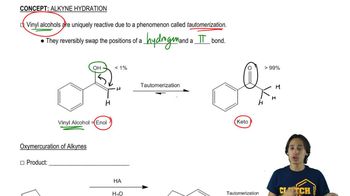
Alkyne Hydration

Ketone Synthesis

Ketones are organic compounds characterized by a carbonyl group (C=O) flanked by two carbon atoms. The synthesis of ketones often involves the reaction of alkynes with specific reagents, such as water in the presence of a catalyst, to yield the desired ketone. Familiarity with the mechanisms of these reactions is essential for determining the appropriate alkyne for a given ketone.
Recommended video:
Guided course
02:27
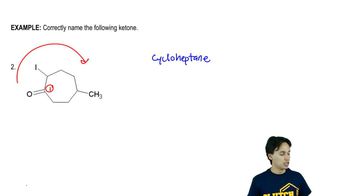
Name the ketone

Reagents and Reaction Conditions

The choice of reagents and reaction conditions significantly influences the outcome of organic reactions. For synthesizing ketones from alkynes, reagents like water, acids, or specific catalysts are often employed. Understanding how these factors affect the reaction pathway is vital for successfully identifying the correct alkyne for the synthesis of the desired ketone.
Recommended video: