Ch. 7 - The Reactions of Alkynes • An Introduction to Multistep Synthesis
Bruice - Organic Chemistry 8th Edition
Bruice8th EditionOrganic ChemistryISBN: 9780135213711Not the one you use?Change textbook
Chapter 8, Problem 13b

Drawing on what you know about the stereochemistry of alkene addition reactions,
b. predict the configuration of the product of the reaction.

Verified step by step guidance
1
Analyze the type of alkene addition reaction involved (e.g., hydrohalogenation, halogenation, hydration, etc.) and determine whether the reaction proceeds via a syn-addition, anti-addition, or a combination of both. This will help predict the stereochemical outcome.
Identify the reagents and reaction conditions provided in the problem. For example, if the reaction involves Br2 in an inert solvent like CCl4, it typically proceeds via anti-addition, forming a trans product.
Draw the starting alkene structure and consider its geometry (e.g., cis or trans configuration). This will influence the stereochemistry of the product.
Apply the stereochemical rules for the specific reaction mechanism. For example, in anti-addition, the two new substituents will add to opposite faces of the double bond, while in syn-addition, they will add to the same face.
Draw the product(s) of the reaction, ensuring that the stereochemistry is clearly indicated (e.g., using wedge and dash bonds to show 3D configuration). If the reaction produces enantiomers or diastereomers, include all possible stereoisomers.

Verified video answer for a similar problem:

This video solution was recommended by our tutors as helpful for the problem above.
Video duration:
2m
Was this helpful?

Key Concepts

Here are the essential concepts you must grasp in order to answer the question correctly.

Stereochemistry

Stereochemistry is the study of the spatial arrangement of atoms in molecules and how this affects their chemical behavior. In the context of alkene addition reactions, it is crucial to understand how the orientation of substituents around the double bond influences the configuration of the product, whether it be cis or trans.
Recommended video:
1:38
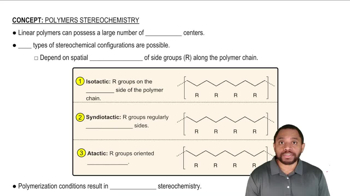
Polymer Stereochemistry Concept 1

Alkene Addition Reactions

Alkene addition reactions involve the addition of reagents across the carbon-carbon double bond of alkenes, resulting in the formation of saturated compounds. The mechanism of these reactions can lead to different stereochemical outcomes, depending on the nature of the reagents and the conditions under which the reaction occurs.
Recommended video:
2:35
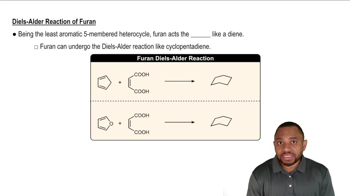
Addition Reactions of Furan Concept 2

Regioselectivity and Stereoselectivity

Regioselectivity refers to the preference of a chemical reaction to yield one structural isomer over others, while stereoselectivity indicates the preference for one stereoisomer over another. In alkene addition reactions, understanding these concepts helps predict the configuration of the product, as certain pathways may favor the formation of specific stereoisomers based on the reaction conditions.
Recommended video:
Guided course
05:09
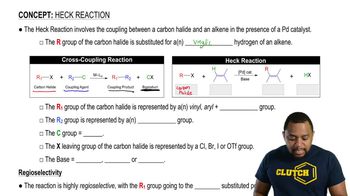
Heck Reaction