Ch. 7 - The Reactions of Alkynes • An Introduction to Multistep Synthesis
Bruice - Organic Chemistry 8th Edition
Bruice8th EditionOrganic ChemistryISBN: 9780135213711Not the one you use?Change textbook
Chapter 8, Problem 19a

Describe the alkyne you should start with and the reagents you should use if you want to synthesize
a. pentane.

Verified step by step guidance
1
Step 1: Understand the target molecule. Pentane is an alkane with five carbon atoms and no double or triple bonds. To synthesize pentane from an alkyne, you need to perform a reduction reaction that converts the alkyne into an alkane.
Step 2: Choose the starting alkyne. To ensure the final product is pentane, you should start with an alkyne that has five carbon atoms, such as 1-pentyne or 2-pentyne. Both are suitable starting materials.
Step 3: Select the reagents for the reduction. To fully reduce the alkyne to an alkane, you can use hydrogen gas (H₂) in the presence of a metal catalyst, such as palladium (Pd) or platinum (Pt). This process is known as catalytic hydrogenation.
Step 4: Perform the reaction. Subject the alkyne to hydrogen gas under pressure in the presence of the metal catalyst. The triple bond will be reduced to a single bond, resulting in the formation of pentane.
Step 5: Verify the product. After the reaction, confirm the structure of the product using techniques such as gas chromatography or NMR spectroscopy to ensure that the final compound is pentane.

Verified video answer for a similar problem:

This video solution was recommended by our tutors as helpful for the problem above.
Video duration:
2m
Was this helpful?

Key Concepts

Here are the essential concepts you must grasp in order to answer the question correctly.

Alkynes

Alkynes are hydrocarbons that contain at least one carbon-carbon triple bond. They are unsaturated compounds and can be represented by the general formula CnH2n-2. Understanding the structure and reactivity of alkynes is crucial for predicting the products of chemical reactions, especially in synthesis.
Recommended video:
Guided course
09:11
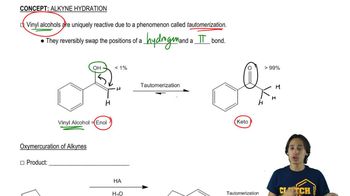
Alkyne Hydration

Synthesis of Alkanes

The synthesis of alkanes, such as pentane, from alkynes typically involves hydrogenation or reduction reactions. This process can convert the triple bond of an alkyne into a single bond, resulting in an alkane. Identifying the correct reagents, such as hydrogen gas (H2) and a catalyst like palladium or platinum, is essential for achieving this transformation.
Recommended video:
Guided course
02:47
Functionalizing Alkanes

Reagents and Reaction Conditions

The choice of reagents and reaction conditions is critical in organic synthesis. For converting an alkyne to pentane, one might use lithium aluminum hydride (LiAlH4) for reduction or hydrogenation with a metal catalyst. Understanding how these reagents interact with alkynes helps in designing effective synthetic pathways to desired products.
Recommended video: