Ch. 7 - The Reactions of Alkynes • An Introduction to Multistep Synthesis
Bruice - Organic Chemistry 8th Edition
Bruice8th EditionOrganic ChemistryISBN: 9780135213711Not the one you use?Change textbook
Chapter 8, Problem 19b

Describe the alkyne you should start with and the reagents you should use if you want to synthesize
b. cis-2-butene.

Verified step by step guidance
1
Step 1: Recognize that cis-2-butene is an alkene with a cis configuration, meaning the two substituents on the double bond are on the same side. To synthesize this, you need to start with an alkyne and perform a partial reduction.
Step 2: Identify the alkyne that can lead to cis-2-butene. The alkyne should have the same carbon skeleton as the desired product. In this case, the starting alkyne is 2-butyne (CH≡C-CH₂-CH₃).
Step 3: Choose the appropriate reagents for partial reduction to achieve the cis configuration. Use Lindlar's catalyst, which is a palladium catalyst poisoned with lead or quinoline, to selectively reduce the alkyne to a cis alkene.
Step 4: Understand the mechanism of the reaction. Lindlar's catalyst facilitates the addition of hydrogen (H₂) to the triple bond in a syn fashion, meaning both hydrogens add to the same side of the molecule, resulting in the cis configuration.
Step 5: Ensure the reaction conditions are mild and avoid over-reduction. Using Lindlar's catalyst prevents the alkyne from being fully reduced to an alkane, stopping at the alkene stage.

Verified video answer for a similar problem:

This video solution was recommended by our tutors as helpful for the problem above.
Video duration:
3m
Was this helpful?

Key Concepts

Here are the essential concepts you must grasp in order to answer the question correctly.

Alkynes

Alkynes are hydrocarbons that contain at least one carbon-carbon triple bond. They are unsaturated compounds and can participate in various chemical reactions, including addition reactions. Understanding the structure and reactivity of alkynes is crucial for determining the appropriate starting material for synthesizing other compounds, such as alkenes.
Recommended video:
Guided course
09:11
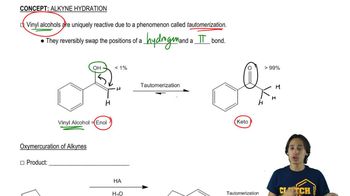
Alkyne Hydration

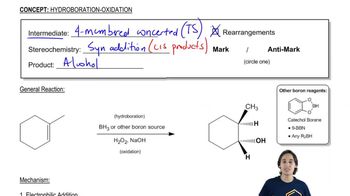
Hydroboration-Oxidation

Hydroboration-oxidation is a two-step reaction process used to convert alkynes into alkenes with specific stereochemistry. In the first step, an alkyl borane is formed, which adds across the triple bond. The subsequent oxidation step replaces the boron with a hydroxyl group, leading to the formation of an alcohol that can be dehydrated to yield the desired alkene, such as cis-2-butene.
Recommended video:
Guided course
06:38
General properties of hydroboration-oxidation.

Stereochemistry

Stereochemistry refers to the spatial arrangement of atoms in molecules and how this affects their chemical properties and reactions. In the case of cis-2-butene, the specific arrangement of substituents around the double bond is crucial for its identification. Understanding stereochemistry is essential for predicting the outcome of reactions and ensuring the correct isomer is synthesized.
Recommended video:
1:38
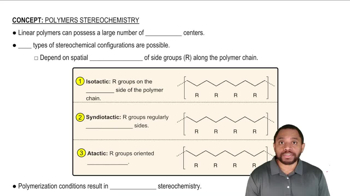
Polymer Stereochemistry Concept 1