Ch. 6 - The Reactions of Alkenes • The Stereochemistry of Addition Reactions
Bruice - Organic Chemistry 8th Edition
Bruice8th EditionOrganic ChemistryISBN: 9780135213711Not the one you use?Change textbook
Chapter 7, Problem 7e,f

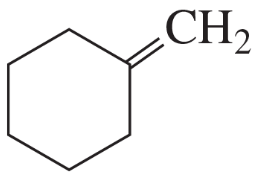
What is the major product obtained from the addition of HBr to each of the following compounds?
e.
f.

Verified step by step guidance
1
Step 1: Analyze the structure of the first compound (cyclohexyl methylene). The double bond is located at the terminal position of the cyclohexane ring. When HBr is added, the reaction follows Markovnikov's rule, where the hydrogen atom from HBr adds to the carbon with more hydrogen atoms, and the bromine atom adds to the carbon with fewer hydrogen atoms.
Step 2: For the first compound, the terminal carbon of the double bond has fewer hydrogen atoms compared to the adjacent carbon. Therefore, bromine will attach to the terminal carbon, forming a bromoalkane.
Step 3: Analyze the structure of the second compound (2-butene). This is an alkene with a double bond between the second and third carbons. The addition of HBr will also follow Markovnikov's rule.
Step 4: For the second compound, the hydrogen atom from HBr will add to the carbon in the double bond that already has more hydrogen atoms (the second carbon), and the bromine atom will add to the carbon with fewer hydrogen atoms (the third carbon). This results in the formation of 2-bromobutane.
Step 5: Consider stereochemistry for the second compound. Since 2-butene can exist as cis or trans isomers, the product may exhibit stereochemical differences depending on the starting isomer. Ensure to account for this when analyzing the major product.

Verified video answer for a similar problem:

This video solution was recommended by our tutors as helpful for the problem above.
Video duration:
1m
Was this helpful?

Key Concepts

Here are the essential concepts you must grasp in order to answer the question correctly.

Electrophilic Addition

Electrophilic addition is a fundamental reaction mechanism in organic chemistry where an electrophile reacts with a nucleophile, typically involving alkenes or alkynes. In this process, the double or triple bond is broken, allowing new atoms or groups to be added to the molecule. Understanding this mechanism is crucial for predicting the products of reactions involving unsaturated compounds, such as the addition of HBr.
Recommended video:
Guided course
09:23
1,2 vs 1,4 Addition

Markovnikov's Rule

Markovnikov's Rule states that when HX (like HBr) adds to an alkene, the hydrogen atom will attach to the carbon with the greater number of hydrogen atoms already attached. This rule helps predict the regioselectivity of the addition reaction, guiding chemists in determining the major product formed. Recognizing this principle is essential for solving problems related to the addition of hydrogen halides to alkenes.
Recommended video:
Guided course
03:54
The 18 and 16 Electron Rule

Carbocation Stability

Carbocation stability is a key concept in organic chemistry that refers to the relative stability of positively charged carbon species. Carbocations can be classified as primary, secondary, or tertiary, with tertiary carbocations being the most stable due to hyperconjugation and inductive effects. Understanding carbocation stability is vital for predicting the pathway and products of electrophilic addition reactions, as the formation of more stable carbocations often leads to the major product.
Recommended video:
Guided course
05:58
Determining Carbocation Stability