
Answer the following questions about the mechanism for the acid-catalyzed hydration of an alkene:
a. How many transition states are there?
b. How many intermediates are there?
c. Which step in the forward direction has the smallest rate constant?
Bruice 8th Edition
Ch. 6 - The Reactions of Alkenes • The Stereochemistry of Addition Reactions
Problem 8d
Verified step by step guidance
Answer the following questions about the mechanism for the acid-catalyzed hydration of an alkene:
a. How many transition states are there?
b. How many intermediates are there?
c. Which step in the forward direction has the smallest rate constant?
What is the major product obtained from the acid-catalyzed hydration of each of the following alkenes?
a. CH3CH2CH2CH=CH2
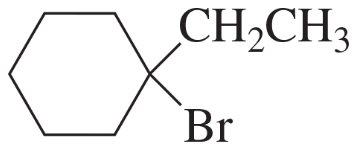
What alkene should be used to synthesize each of the following alkyl bromides?
c.
What alkene should be used to synthesize each of the following alkyl bromides?
b.
What is the major product obtained from the addition of HBr to each of the following compounds?
e.
f.
The pKa of a protonated alcohol is about -2.5, and the pKa of an alcohol is about 15. Therefore, as long as the pH of the solution is greater than _______ and less than _______, more than 50% of 2-propanol (the product of the reaction on p. 244) will be in its neutral, nonprotonated form.