Ch. 6 - The Reactions of Alkenes • The Stereochemistry of Addition Reactions
Bruice - Organic Chemistry 8th Edition
Bruice8th EditionOrganic ChemistryISBN: 9780135213711Not the one you use?Change textbook
Chapter 7, Problem 6a,b

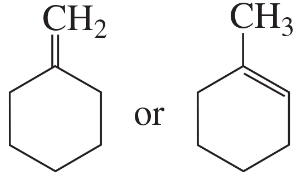
To which compound is the addition of HBr more highly regioselective?
a.
b.

Verified step by step guidance
1
Step 1: Understand the concept of regioselectivity in addition reactions. Regioselectivity refers to the preference for the formation of one constitutional isomer over another in a chemical reaction. In the case of HBr addition to alkenes, the Markovnikov rule applies, which states that the hydrogen atom from HBr will add to the carbon with more hydrogen atoms (less substituted), and the bromine atom will add to the carbon with fewer hydrogen atoms (more substituted).
Step 2: Analyze the first pair of compounds (CH3CH2C=CH2 vs CH3C=CHCH3). In CH3CH2C=CH2, the double bond is terminal, meaning one of the carbons in the double bond is bonded to only one other carbon atom. In CH3C=CHCH3, the double bond is internal, meaning both carbons in the double bond are bonded to other carbon atoms. Terminal alkenes generally exhibit higher regioselectivity because the difference in substitution between the two carbons in the double bond is more pronounced.
Step 3: Analyze the second pair of compounds (cyclohexene with CH2 vs cyclohexene with CH3). In the first compound, the double bond is terminal, with one carbon bonded to only one other carbon atom. In the second compound, the double bond is internal, with both carbons bonded to other carbon atoms. Similar to the first pair, terminal alkenes tend to show higher regioselectivity due to the greater difference in substitution between the two carbons in the double bond.
Step 4: Compare the regioselectivity of HBr addition to the compounds in each pair. For both pairs, the terminal alkenes (CH3CH2C=CH2 and cyclohexene with CH2) are expected to exhibit higher regioselectivity because the Markovnikov addition of HBr is more pronounced when there is a clear difference in substitution between the two carbons in the double bond.
Step 5: Conclude that the addition of HBr is more highly regioselective to the terminal alkenes in both pairs of compounds. This is due to the greater difference in substitution between the carbons in the double bond, which makes the Markovnikov rule more applicable.

Verified video answer for a similar problem:

This video solution was recommended by our tutors as helpful for the problem above.
Video duration:
4m
Was this helpful?

Key Concepts

Here are the essential concepts you must grasp in order to answer the question correctly.

Regioselectivity

Regioselectivity refers to the preference of a chemical reaction to occur at one location over another in a molecule. In the context of electrophilic addition reactions, such as the addition of HBr to alkenes, regioselectivity determines which carbon atom of the double bond will bond with the bromine atom and which will bond with the hydrogen atom, leading to different products.
Recommended video:
Guided course
05:09
Heck Reaction

Markovnikov's Rule

Markovnikov's Rule states that in the addition of HX (where X is a halogen) to an alkene, the hydrogen atom will attach to the carbon with the greater number of hydrogen atoms already attached. This rule helps predict the major product of the reaction, as it indicates the regioselectivity based on the stability of the carbocation intermediates formed during the reaction.
Recommended video:
Guided course
03:54
The 18 and 16 Electron Rule

Carbocation Stability

Carbocation stability is a key factor in determining the outcome of electrophilic addition reactions. More stable carbocations, such as tertiary carbocations, are favored during the reaction process. The stability is influenced by factors such as the degree of substitution and resonance, which can affect the regioselectivity of the addition of HBr to alkenes.
Recommended video:
Guided course
05:58
Determining Carbocation Stability