Ch. 28 - Pericyclic Reactions
Bruice - Organic Chemistry 8th Edition
Bruice8th EditionOrganic ChemistryISBN: 9780135213711Not the one you use?Change textbook
Chapter 25, Problem 16

Show how 5-methyl-1,3-cyclopentadiene rearranges to form 1-methyl-1,3-cyclopentadiene and 2-methyl-1,3-cyclopentadiene.

Verified step by step guidance
1
Identify the starting compound, 5-methyl-1,3-cyclopentadiene, which is a conjugated diene with a methyl group attached to the fifth carbon of the cyclopentadiene ring.
Recognize that the reaction involves a [1,5]-sigmatropic shift, a type of pericyclic reaction where a substituent (in this case, the methyl group) migrates across the conjugated π-system of the diene.
Draw the mechanism for the [1,5]-sigmatropic shift: the π-electrons of the conjugated diene rearrange, and the methyl group moves from the fifth carbon to the first carbon, forming 1-methyl-1,3-cyclopentadiene.
Consider the possibility of a second [1,5]-sigmatropic shift: the methyl group on the first carbon can migrate again across the conjugated π-system to the second carbon, forming 2-methyl-1,3-cyclopentadiene.
Verify the structures of the products (1-methyl-1,3-cyclopentadiene and 2-methyl-1,3-cyclopentadiene) to ensure that the rearrangements preserve the conjugated diene system and follow the rules of pericyclic reactions.

Verified video answer for a similar problem:

This video solution was recommended by our tutors as helpful for the problem above.
Video duration:
7m
Was this helpful?

Key Concepts

Here are the essential concepts you must grasp in order to answer the question correctly.

Cyclopentadiene Structure

Cyclopentadiene is a five-membered ring compound containing two double bonds. Its structure allows for unique reactivity due to the presence of conjugated double bonds, which can participate in various rearrangements and reactions. Understanding the geometry and electronic configuration of cyclopentadiene is crucial for predicting its behavior during rearrangement.
Recommended video:
Guided course
03:04
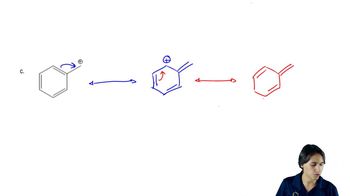
Drawing Resonance Structures

Rearrangement Mechanisms

Rearrangement mechanisms involve the reorganization of atoms within a molecule to form a new structure. In the case of 5-methyl-1,3-cyclopentadiene, the rearrangement can occur through a series of bond-breaking and bond-forming steps, often facilitated by the stability of intermediates. Recognizing the types of rearrangements, such as 1,2-shifts or ring expansions, is essential for understanding the transformation into 1-methyl-1,3-cyclopentadiene and 2-methyl-1,3-cyclopentadiene.
Recommended video:
Guided course
06:08
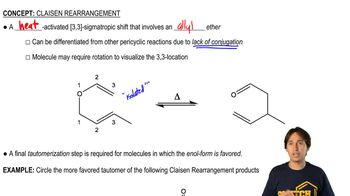
Definition of Claisen Rearrangement

Stability of Intermediates

The stability of reaction intermediates plays a significant role in determining the pathway and products of a rearrangement reaction. In this case, the formation of stable carbocation or radical intermediates can influence whether the rearrangement favors the formation of 1-methyl-1,3-cyclopentadiene or 2-methyl-1,3-cyclopentadiene. Analyzing the stability of these intermediates helps predict the outcome of the rearrangement process.
Recommended video:
Guided course
04:31
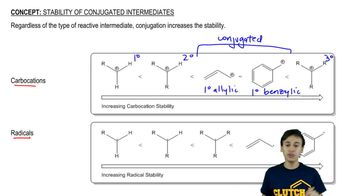
Stability of Conjugated Intermediates