Ch. 28 - Pericyclic Reactions
Bruice - Organic Chemistry 8th Edition
Bruice8th EditionOrganic ChemistryISBN: 9780135213711Not the one you use?Change textbook
Chapter 25, Problem 18a

a. Will thermal 1,3-migrations of carbon occur with retention or inversion of configuration?

Verified step by step guidance
1
Understand the concept of a 1,3-migration: A 1,3-migration involves the movement of a substituent (in this case, a carbon group) from one atom to another within a molecule, specifically over a distance of three atoms. This process often occurs under thermal conditions and involves a concerted mechanism.
Recognize the stereochemical implications: In a concerted reaction mechanism, the migration of the substituent and the reorganization of bonding orbitals occur simultaneously. This means that the stereochemistry of the migrating group is directly influenced by the orbital alignment during the transition state.
Analyze the orbital interactions: During a thermal 1,3-migration, the reaction typically proceeds through a suprafacial pathway (on the same face of the molecule) if the system has a favorable orbital overlap. This suprafacial migration leads to retention of configuration at the migrating carbon center.
Consider the Woodward-Hoffmann rules: These rules help predict the stereochemical outcome of pericyclic reactions. For a thermal 1,3-migration, the reaction follows the conservation of orbital symmetry, which supports retention of configuration for the migrating group.
Conclude the stereochemical outcome: Based on the concerted mechanism, orbital interactions, and the Woodward-Hoffmann rules, thermal 1,3-migrations of carbon occur with retention of configuration at the migrating carbon center.

Verified video answer for a similar problem:

This video solution was recommended by our tutors as helpful for the problem above.
Video duration:
6m
Was this helpful?

Key Concepts

Here are the essential concepts you must grasp in order to answer the question correctly.

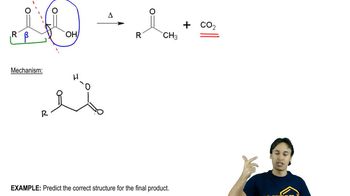
1,3-Migration Mechanism

1,3-migrations refer to the rearrangement of a substituent from one carbon atom to another that is three positions away in a molecule. This process often occurs in the context of rearrangements involving carbocations or radical intermediates. Understanding the mechanism is crucial for predicting the stereochemical outcome of the migration.
Recommended video:
Guided course
04:32
General Mechanism

Retention vs. Inversion of Configuration

Retention and inversion of configuration describe how the spatial arrangement of atoms around a chiral center changes during a reaction. Retention means the configuration remains the same, while inversion indicates a switch in the arrangement. The stereochemical outcome of a migration can depend on the nature of the intermediates and the reaction conditions.
Recommended video:
Guided course
02:14
The Electron Configuration

Thermal vs. Photochemical Reactions

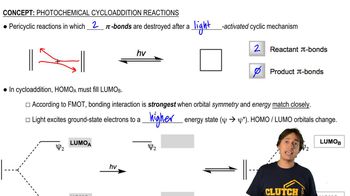
Thermal reactions occur at elevated temperatures and typically involve the breaking and forming of bonds without the need for light. In contrast, photochemical reactions are driven by light energy. The conditions under which a 1,3-migration occurs can influence whether the reaction leads to retention or inversion of configuration, making it essential to consider the thermal context.
Recommended video:
Guided course
09:36
MO Theory of Photochemical Cycloadditions