Ch. 28 - Pericyclic Reactions
Bruice - Organic Chemistry 8th Edition
Bruice8th EditionOrganic ChemistryISBN: 9780135213711Not the one you use?Change textbook
Chapter 25, Problem 15

Account for the difference in the products obtained under photochemical and thermal conditions:
Chemical reaction diagram showing products under photochemical and thermal conditions with labeled reactants and products.

Verified step by step guidance
1
Understand the key difference between photochemical and thermal conditions: Photochemical reactions are driven by light energy (usually UV or visible light), which excites electrons to higher energy states, while thermal reactions are driven by heat energy, which increases molecular vibrations and collisions.
Identify the type of reaction involved. For example, under photochemical conditions, reactions often involve radical intermediates due to the homolytic cleavage of bonds caused by light energy. In contrast, thermal conditions typically favor ionic or concerted mechanisms depending on the energy provided.
Examine the molecular structure of the reactants. Determine which bonds are likely to break or form under photochemical conditions (e.g., bonds with lower dissociation energy may undergo homolytic cleavage) versus thermal conditions (e.g., bonds that can be broken by heat energy).
Consider the reaction mechanism. Under photochemical conditions, the excited state of the molecule may lead to unique pathways, such as radical recombination or rearrangements. Under thermal conditions, the reaction may proceed through a more conventional pathway, such as nucleophilic substitution or elimination.
Analyze the products formed. Photochemical reactions often yield products that are less predictable due to the involvement of radicals and excited states, while thermal reactions tend to produce more stable and thermodynamically favored products. Compare the stability and structure of the products under each condition.

Verified video answer for a similar problem:

This video solution was recommended by our tutors as helpful for the problem above.
Was this helpful?

Key Concepts

Here are the essential concepts you must grasp in order to answer the question correctly.

Photochemical Reactions

Photochemical reactions are chemical processes that occur when molecules absorb light energy, leading to the formation of different products compared to thermal reactions. The energy from light can promote electrons to higher energy states, facilitating bond breaking and formation in unique ways. This often results in radical intermediates, which can lead to diverse reaction pathways and products.
Recommended video:
Guided course
09:36
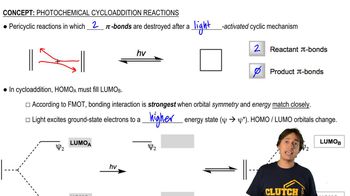
MO Theory of Photochemical Cycloadditions

Thermal Reactions

Thermal reactions are driven by heat energy, which increases the kinetic energy of molecules, allowing them to overcome activation energy barriers. These reactions typically proceed through more stable intermediates and follow classical reaction mechanisms, such as concerted or stepwise pathways. The products formed under thermal conditions are often different from those formed under photochemical conditions due to the absence of radical species.
Recommended video:
Guided course
06:36
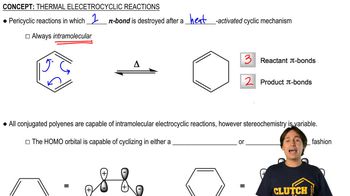
MO Theory of Thermal Electrocyclics

Reaction Mechanisms

Reaction mechanisms describe the step-by-step sequence of elementary reactions that occur during a chemical transformation. Understanding the mechanism is crucial for predicting the products of a reaction, as it reveals how bonds are broken and formed. The differences in mechanisms between photochemical and thermal reactions can lead to distinct products, highlighting the importance of energy source in determining reaction pathways.
Recommended video:
Guided course
02:16
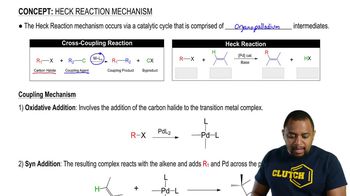
Heck Reaction Mechanism