
Ch. 22 - Catalysis in Organic Reactions and in Enzymatic Reactions
Bruice - Organic Chemistry 8th Edition
Bruice8th EditionOrganic ChemistryISBN: 9780135213711Not the one you use?Change textbook
Chapter 23, Problem 43a

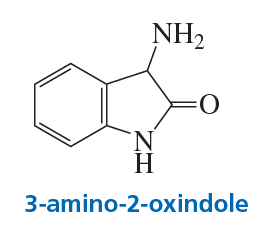
3-Amino-2-oxindole catalyzes the decarboxylation of a-keto acids.
a. Propose a mechanism for the catalyzed reaction.
Chemical structure of 3-amino-2-oxindole, highlighting its role in catalyzing decarboxylation reactions.

Verified step by step guidance
1
Identify the functional groups in 3-Amino-2-oxindole and the α-keto acid. The 3-Amino-2-oxindole contains an amine group (-NH2) and a ketone group within the indole structure, while the α-keto acid contains a carboxylic acid (-COOH) and a ketone (-C=O) on the α-carbon.
Recognize the role of 3-Amino-2-oxindole as a catalyst. The amine group can act as a nucleophile, initiating the reaction by interacting with the α-keto acid. This interaction facilitates the decarboxylation process.
Propose the first step of the mechanism: The amine group of 3-Amino-2-oxindole attacks the carbonyl carbon of the α-keto acid, forming a tetrahedral intermediate. This step involves nucleophilic addition.
Describe the decarboxylation step: The tetrahedral intermediate undergoes rearrangement, leading to the loss of carbon dioxide (CO2) from the carboxylic acid group. This step is facilitated by the electron-withdrawing nature of the ketone group on the α-carbon.
Explain the regeneration of the catalyst: After decarboxylation, the intermediate collapses, releasing the product (an aldehyde or ketone) and regenerating the 3-Amino-2-oxindole catalyst for further reaction cycles.

Verified video answer for a similar problem:

This video solution was recommended by our tutors as helpful for the problem above.
Was this helpful?

Key Concepts

Here are the essential concepts you must grasp in order to answer the question correctly.

Decarboxylation

Decarboxylation is a chemical reaction that involves the removal of a carboxyl group (-COOH) from a molecule, resulting in the release of carbon dioxide (CO2). This process is crucial in organic chemistry, particularly in the metabolism of amino acids and the synthesis of various organic compounds. Understanding the conditions and mechanisms that facilitate decarboxylation is essential for proposing accurate reaction pathways.
Recommended video:
Guided course
02:32
Predict the correct structure

Catalysis

Catalysis refers to the process by which a substance, known as a catalyst, increases the rate of a chemical reaction without being consumed in the process. In the context of organic reactions, catalysts can provide an alternative reaction pathway with a lower activation energy. Understanding how 3-amino-2-oxindole acts as a catalyst in the decarboxylation of α-keto acids is key to proposing a detailed mechanism for the reaction.
Recommended video:
2:31
Nucleophilic Catalysis Concept 1

Mechanism of Reaction

The mechanism of a reaction describes the step-by-step sequence of elementary reactions by which overall chemical change occurs. It includes the formation and breaking of bonds, the transition states, and the intermediates involved. Proposing a mechanism for the decarboxylation catalyzed by 3-amino-2-oxindole requires a clear understanding of these steps, including how the catalyst interacts with the substrate and facilitates the reaction.
Recommended video:
Guided course
02:16
Heck Reaction Mechanism
Related Practice
Textbook Question

Triosephosphate isomerase (TIM) catalyzes the conversion of dihydroxyacetone phosphate to glyceraldehyde-3-phosphate. The enzyme’s catalytic groups are Glu 165 and His 95. In the first step of the reaction, these catalytic groups function as a general-base and a general-acid catalyst, respectively. Propose a mechanism for the reaction.

Textbook Question

2-Acetoxycyclohexyl tosylate reacts with acetate ion to form 1,2-cyclohexanediol diacetate. The reaction is stereospecific—that is, the stereoisomers obtained as products depend on the stereoisomer used as a reactant. Recall that because 2-acetoxycyclohexyl tosylate has two asymmetric centers, it has four stereoisomers—two are cis and two are trans. Explain the following observations:

b. Both trans reactants form the same racemic mixture.

2
views
Textbook Question

2-Acetoxycyclohexyl tosylate reacts with acetate ion to form 1,2-cyclohexanediol diacetate. The reaction is stereospecific—that is, the stereoisomers obtained as products depend on the stereoisomer used as a reactant. Recall that because 2-acetoxycyclohexyl tosylate has two asymmetric centers, it has four stereoisomers—two are cis and two are trans. Explain the following observations:

c. A trans reactant is more reactive than a cis reactant.

2
views
Textbook Question

Proof that an imine was formed between aldolase and its substrate was obtained by using D-fructose-1,6-bisphosphate labeled at the C-2 position with 14C as the substrate. NaBH4 was added to the reaction mixture. A radioactive product was isolated from the reaction mixture and hydrolyzed in an acidic solution. Draw the structure of the radioactive product obtained from the acidic solution. (Hint: NaBH4 reduces an imine linkage.)

1
views
Textbook Question

Explain why the alkyl halide shown here reacts much more rapidly with guanine than does a primary alkyl halide (such as pentyl chloride).

2
views