Ch. 22 - Catalysis in Organic Reactions and in Enzymatic Reactions
Bruice - Organic Chemistry 8th Edition
Bruice8th EditionOrganic ChemistryISBN: 9780135213711Not the one you use?Change textbook
Chapter 23, Problem 45

Triosephosphate isomerase (TIM) catalyzes the conversion of dihydroxyacetone phosphate to glyceraldehyde-3-phosphate. The enzyme’s catalytic groups are Glu 165 and His 95. In the first step of the reaction, these catalytic groups function as a general-base and a general-acid catalyst, respectively. Propose a mechanism for the reaction.

Verified step by step guidance
1
Step 1: Identify the functional groups involved in the reaction. Dihydroxyacetone phosphate contains a ketone group, while glyceraldehyde-3-phosphate contains an aldehyde group. The reaction involves an isomerization, specifically the interconversion of a ketone to an aldehyde.
Step 2: Recognize the role of the catalytic groups. Glu 165 acts as a general base, meaning it will abstract a proton, while His 95 acts as a general acid, meaning it will donate a proton during the reaction.
Step 3: Propose the first step of the mechanism. Glu 165 abstracts a proton from the hydroxyl group adjacent to the ketone in dihydroxyacetone phosphate, forming an enolate intermediate. This step stabilizes the negative charge on the oxygen atom through resonance.
Step 4: Describe the proton transfer facilitated by His 95. His 95 donates a proton to the enolate intermediate, converting it into an aldehyde group. This step completes the isomerization process.
Step 5: Conclude the mechanism. The final product, glyceraldehyde-3-phosphate, is formed after the proton transfer. The enzyme triosephosphate isomerase stabilizes the transition state and ensures the reaction proceeds efficiently.

Verified video answer for a similar problem:

This video solution was recommended by our tutors as helpful for the problem above.
Video duration:
11m
Was this helpful?

Key Concepts

Here are the essential concepts you must grasp in order to answer the question correctly.

Enzyme Catalysis

Enzyme catalysis refers to the process by which enzymes accelerate chemical reactions in biological systems. Enzymes lower the activation energy required for reactions, allowing them to occur more rapidly and efficiently. In the case of triosephosphate isomerase (TIM), the enzyme facilitates the interconversion of dihydroxyacetone phosphate and glyceraldehyde-3-phosphate through specific catalytic mechanisms involving amino acid residues.
Recommended video:
2:31
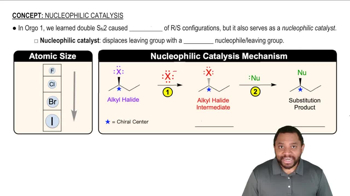
Nucleophilic Catalysis Concept 1

General Acid-Base Catalysis

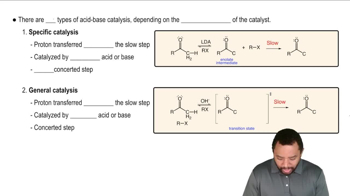
General acid-base catalysis involves the transfer of protons (H+) to or from substrates during a chemical reaction, enhancing the reaction rate. In the context of TIM, Glu 165 acts as a general base, accepting a proton, while His 95 serves as a general acid, donating a proton. This interplay of proton transfer is crucial for stabilizing transition states and facilitating the conversion of substrates.
Recommended video:
2:50
Acid-Base Catalysis Concept 3

Mechanism of Enzyme Action

The mechanism of enzyme action describes the step-by-step process by which an enzyme converts substrates into products. This includes the formation of an enzyme-substrate complex, the transition state, and the release of products. Understanding the specific roles of catalytic residues, such as Glu 165 and His 95 in TIM, is essential for proposing a detailed mechanism that outlines how these residues contribute to the reaction pathway.
Recommended video:
Guided course
04:32
General Mechanism