
Ch. 22 - Catalysis in Organic Reactions and in Enzymatic Reactions
Bruice - Organic Chemistry 8th Edition
Bruice8th EditionOrganic ChemistryISBN: 9780135213711Not the one you use?Change textbook
Chapter 23, Problem 41b

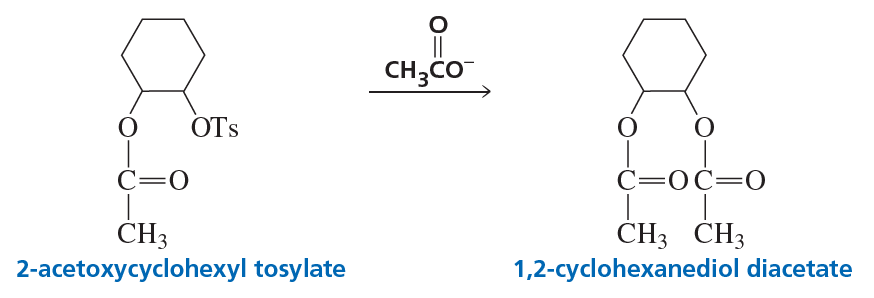
2-Acetoxycyclohexyl tosylate reacts with acetate ion to form 1,2-cyclohexanediol diacetate. The reaction is stereospecific—that is, the stereoisomers obtained as products depend on the stereoisomer used as a reactant. Recall that because 2-acetoxycyclohexyl tosylate has two asymmetric centers, it has four stereoisomers—two are cis and two are trans. Explain the following observations:
b. Both trans reactants form the same racemic mixture.
Chemical reaction diagram showing 2-acetoxycyclohexyl tosylate converting to 1,2-cyclohexanediol diacetate.

Verified step by step guidance
1
Step 1: Analyze the structure of 2-acetoxycyclohexyl tosylate. It contains two asymmetric centers, which means it can exist as four stereoisomers: two cis and two trans. The trans isomers have substituents on opposite sides of the cyclohexane ring.
Step 2: Understand the reaction mechanism. The acetate ion (CH₃CH₂CO⁻) acts as a nucleophile and performs an SN2 reaction on the tosylate group. SN2 reactions proceed with inversion of configuration at the carbon undergoing substitution.
Step 3: Consider the stereochemistry of the trans isomers. In both trans isomers, the acetate ion attacks the carbon attached to the tosylate group, leading to inversion of configuration at that center. This inversion results in the formation of a product with a specific stereochemistry.
Step 4: Examine the product formation. After the SN2 reaction, the intermediate undergoes intramolecular nucleophilic attack by the acetate group on the second asymmetric center, leading to the formation of 1,2-cyclohexanediol diacetate. This step is also stereospecific.
Step 5: Explain why both trans reactants form the same racemic mixture. Due to the symmetry of the trans isomers and the stereospecific nature of the reaction, the inversion and subsequent attack result in products that are mirror images of each other. These mirror images form a racemic mixture, regardless of which trans isomer is used as the reactant.

Verified video answer for a similar problem:

This video solution was recommended by our tutors as helpful for the problem above.
Video duration:
12m
Was this helpful?

Key Concepts

Here are the essential concepts you must grasp in order to answer the question correctly.

Stereochemistry

Stereochemistry is the study of the spatial arrangement of atoms in molecules and how this affects their chemical behavior. In this reaction, the stereochemistry of the reactants influences the stereochemical outcome of the products. The presence of asymmetric centers in the reactants leads to different stereoisomers, which can yield distinct products based on their spatial orientation.
Recommended video:
1:38
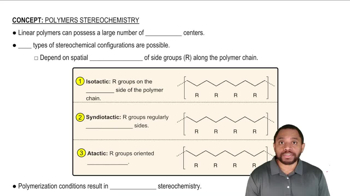
Polymer Stereochemistry Concept 1

Racemic Mixture

A racemic mixture is a 1:1 mixture of two enantiomers, which are molecules that are mirror images of each other. In the context of this reaction, both trans isomers of the 2-acetoxycyclohexyl tosylate react to form the same racemic mixture of products. This occurs because the reaction mechanism allows for the formation of both enantiomers equally, resulting in a racemic outcome regardless of the specific trans isomer used.
Recommended video:
Guided course
03:08
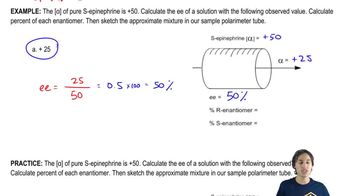
Calculating EE, percent of each enantiomer, and sketching mixture

Nucleophilic Substitution

Nucleophilic substitution is a fundamental reaction mechanism in organic chemistry where a nucleophile replaces a leaving group in a molecule. In this case, the acetate ion acts as the nucleophile that attacks the electrophilic carbon in the tosylate, leading to the formation of 1,2-cyclohexanediol diacetate. The stereospecific nature of this reaction means that the configuration of the starting material directly influences the stereochemistry of the product.
Recommended video:
Guided course
01:47
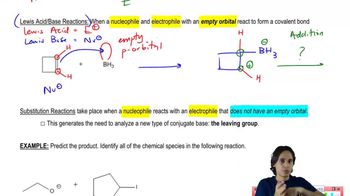
Nucleophiles and Electrophiles can react in Substitution Reactions.
Related Practice
Textbook Question

Carbonic anhydrase is an enzyme that catalyzes the conversion of carbon dioxide to bicarbonate ion. It is a metalloenzyme, with Zn2+ coordinated at the active site by three histidine side chains. Propose a mechanism for the reaction.

2
views
Textbook Question

3-Amino-2-oxindole catalyzes the decarboxylation of a-keto acids.

a. Propose a mechanism for the catalyzed reaction.

1
views
Textbook Question

2-Acetoxycyclohexyl tosylate reacts with acetate ion to form 1,2-cyclohexanediol diacetate. The reaction is stereospecific—that is, the stereoisomers obtained as products depend on the stereoisomer used as a reactant. Recall that because 2-acetoxycyclohexyl tosylate has two asymmetric centers, it has four stereoisomers—two are cis and two are trans. Explain the following observations:

c. A trans reactant is more reactive than a cis reactant.

2
views
Textbook Question

Propose a mechanism for the following reaction. (Hint: The rate of the reaction is much slower if the nitrogen atom is replaced by CH.)

3
views
Textbook Question

Proof that an imine was formed between aldolase and its substrate was obtained by using D-fructose-1,6-bisphosphate labeled at the C-2 position with 14C as the substrate. NaBH4 was added to the reaction mixture. A radioactive product was isolated from the reaction mixture and hydrolyzed in an acidic solution. Draw the structure of the radioactive product obtained from the acidic solution. (Hint: NaBH4 reduces an imine linkage.)

1
views
Textbook Question

2-Acetoxycyclohexyl tosylate reacts with acetate ion to form 1,2-cyclohexanediol diacetate. The reaction is stereospecific—that is, the stereoisomers obtained as products depend on the stereoisomer used as a reactant. Recall that because 2-acetoxycyclohexyl tosylate has two asymmetric centers, it has four stereoisomers—two are cis and two are trans. Explain the following observations:

a. Both cis reactants form an optically active trans product, but each cis reactant forms a different trans product.

1
views