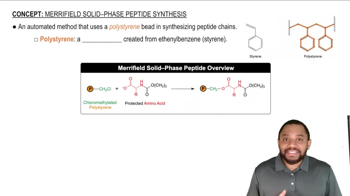
Show the steps in the synthesis of the tetrapeptide in Problem 34, using Merrifield's method.
Ch. 21 - Amino Acids, Peptides, and Proteins
Chapter 22, Problem 34
Show the steps in the synthesis of the tetrapeptide Leu-Phe-Ala-Val.
Verified step by step guidance1
Step 1: Protect the amino group of the first amino acid (Leucine) using a protecting group such as tert-butyloxycarbonyl (Boc) to prevent unwanted reactions. This forms Boc-Leu.
Step 2: Activate the carboxyl group of the second amino acid (Phenylalanine) using a coupling reagent like dicyclohexylcarbodiimide (DCC) or HATU. This allows the formation of a peptide bond. React Boc-Leu with activated Phe to form Boc-Leu-Phe.
Step 3: Deprotect the Boc group from Boc-Leu-Phe using an acid such as trifluoroacetic acid (TFA) to expose the free amino group. This gives Leu-Phe with a free amino group.
Step 4: Repeat the process for the next amino acid (Alanine). Protect the amino group of Alanine with Boc, activate its carboxyl group, and couple it with the free amino group of Leu-Phe. This forms Boc-Leu-Phe-Ala.
Step 5: Finally, deprotect the Boc group from Boc-Leu-Phe-Ala and couple it with the activated Valine (using the same activation and coupling strategy). This results in the tetrapeptide Leu-Phe-Ala-Val.

Verified video answer for a similar problem:
This video solution was recommended by our tutors as helpful for the problem above.
Video duration:
9mWas this helpful?
Key Concepts
Here are the essential concepts you must grasp in order to answer the question correctly.
Peptide Synthesis
Peptide synthesis involves the formation of peptide bonds between amino acids to create peptides. This process typically follows the stepwise addition of protected amino acids, where the carboxyl group of one amino acid reacts with the amino group of another, releasing water. Understanding the mechanisms of peptide bond formation is crucial for synthesizing specific sequences like tetrapeptides.
Recommended video:
Merrifield Solid-Phase Peptide Synthesis Concept 1
Amino Acid Protection
In peptide synthesis, protecting groups are used to prevent unwanted reactions at the functional groups of amino acids. For example, the amino group can be protected with a group like Fmoc or Boc, allowing for selective coupling of amino acids in a desired sequence. Mastery of protection and deprotection strategies is essential for successful synthesis.
Recommended video:
Guided course
Standard Amino Acids
Solid-Phase Peptide Synthesis (SPPS)
Solid-phase peptide synthesis (SPPS) is a widely used method for synthesizing peptides, where the growing peptide chain is anchored to a solid resin. This technique allows for easy washing and purification of intermediates, facilitating the stepwise addition of amino acids. Understanding SPPS is vital for efficiently synthesizing complex peptides like Leu-Phe-Ala-Val.
Recommended video:
Merrifield Solid-Phase Peptide Synthesis Concept 1
Related Practice
Textbook Question
1
views
Textbook Question
An opioid pentapeptide has the following structure: Tyr-Cys-Gly-Phe-Cys
a. Draw the structure of the pentapeptide including all the side chains.
b. Write its structure following mild oxidation.
2
views
Textbook Question
What is the configuration about each of the asymmetric centers in aspartame?
1
views
Textbook Question
What dipeptides would be formed by heating a mixture of valine and N-protected leucine?
3
views
Textbook Question
a. Calculate the overall yield of bradykinin when the yield for the addition of each amino acid to the chain is 70%.
b. What would be the overall yield of a peptide containing 15 amino acids if the yield for the incorporation of each is 80%
1
views
Textbook Question
Write the mechanism for the reaction of a cysteine side chain with iodoacetic acid.
4
views